
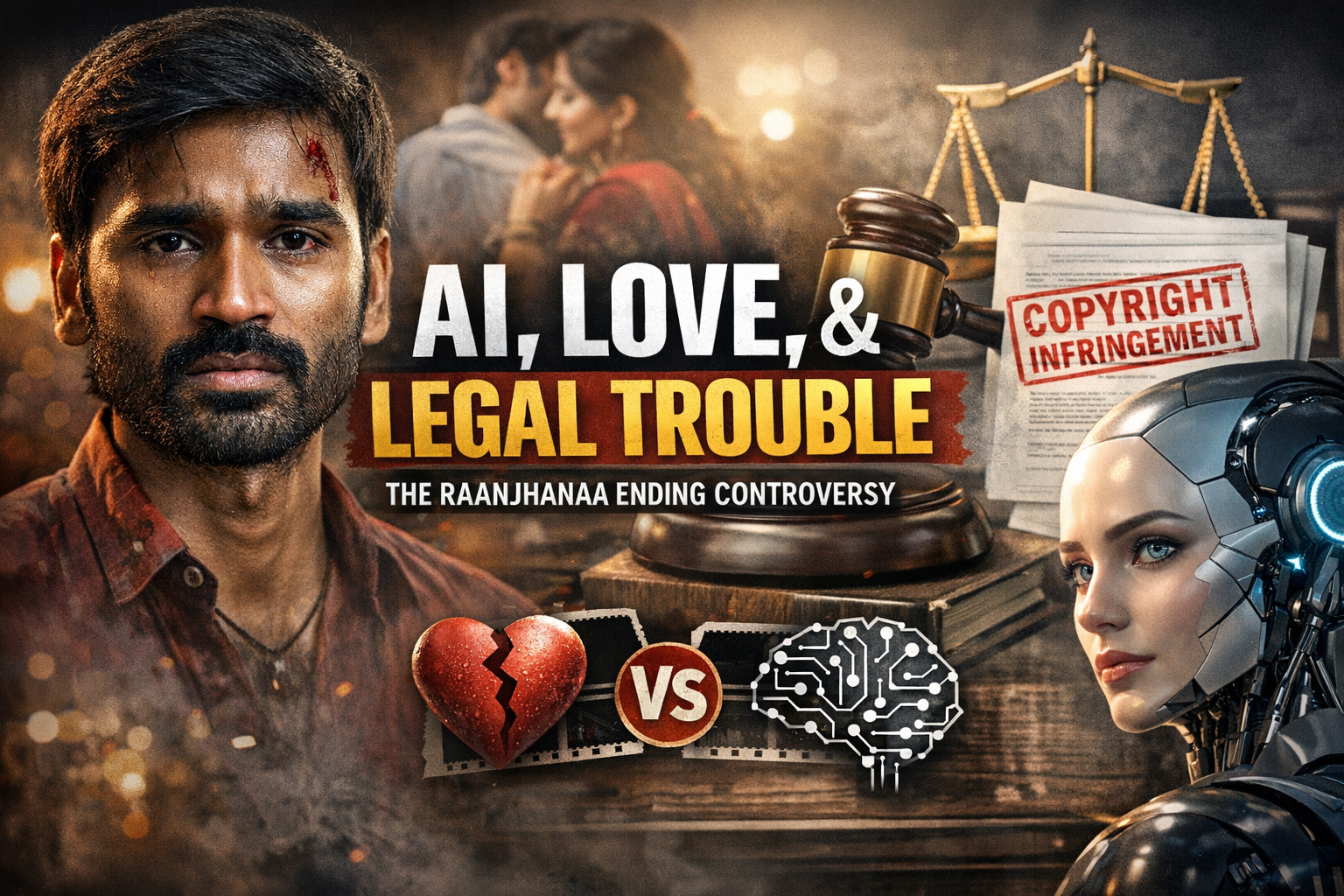
AI, Love, and Legal Trouble: The Raanjhanaa Ending That Sparked a Storm
BACKGROUND: A LOVE STORY THAT REFUSES TO DIE
Released in 2013, Raanjhanaa quickly became a cult classic, blending the unrequited love of Kundan i.e played by Dhanush with a complex socio-political drama. The film’s tragic ending left many fans heartbroken and yearning for closure. Fast forward to 2025, the film re-emerged in public conversation, not because of a sequel by its original creators, but due to an AI-generated alternate ending that went viral. In this AI-generated version, Kundan survives, and the film explores an entirely new arc one that resonated deeply with fans and reignited debates across the entertainment and legal landscapes.
HOW IT STARTED: AI REWRITES THE ENDING
In early 2025, a fan using the handle @KundanLives released a 15-minute short film titled Raanjhanaa Reimagined. Created using advanced generative AI tools likely a combination of text-to-video generators, voice cloning, and scriptwriting AI this version of the story portrayed an alternate ending where Kundan survives. New plot arcs, dialogues, and visual aesthetics that closely mirrored the original were generated entirely through AI.
The project quickly evolved into more than just a video. A screenplay script and a teaser trailer accompanied the release. Despite disclaimers that it was a fan tribute, the teaser hinted at a “full-length” continuation, which fueled speculation. Within days, the content amassed millions of views across YouTube, Reddit, and Instagram. Fan petitions began circulating demanding an official sequel inspired by this alternate ending. Some streaming platforms reportedly expressed informal interest in acquiring or adapting the AI-based narrative.
But this wave of fan-driven creativity was met with immediate backlash from the film’s original creators.
Section 2(uu) of the Copyright Act, 1957 defines “producer”, in relation to a cinematograph film or sound recording, means a person who takes the initiative and responsibility for making the work” a producer as the one who takes the “initiative and responsibility” for making the work. In Raanjhanaa’s case, that legal footing is now clashing with the surging tide of creative sentiment. While @KundanLives claims no commercial intent and cites the project as a tribute, legal experts point out that the original producer retains exclusive rights not just to distribution, but to any derivative works.
As news broke about the film’s re-release featuring an AI-altered ending, director Aanand L. Rai was reportedly caught off guard. He described the unauthorized changes as nothing short of “artistic vandalism.”
THE ORIGINAL CREATORS STRIKE BACK
By mid-2025, Raanjhanaa producer Eros International, director Aanand L. Rai, and writer Himanshu Sharma responded with strong objections. In a public statement, Rai emphasized: “Creativity has boundaries. AI cannot be used to rewrite our stories without permission.” The team raised multiple legal and ethical concerns:
- Copyright Infringement: The AI-generated content borrowed characters, themes, and the cinematic world of Raanjhanaa all of which are protected under the Indian Copyright Act.
- Moral Rights Violation: The reinterpretation altered the emotional and narrative intent of the original, potentially damaging the creators’ vision. Under Section 57 of the Act, authors have the right to object to distortion or modification of their work.
- Unlicensed Commercial Activity: The teaser’s promotional tone hinted at a release, raising red flags about monetization and potential profit-making, despite disclaimers.
- Following this, a legal notice was issued to have the AI content removed from platforms like YouTube, Vimeo, and Reddit.
THE FAN CREATOR’S ARGUMENT
The anonymous creator behind the project @KundanLives, pushed back. Posting on X (formerly Twitter), they claimed the AI version was:
- A non-commercial tribute created out of emotional connection with the film’s characters. @KundanLives emphasized that Raanjhanaa Reimagined was never intended for profit or commercial gain. Instead, they described it as a deeply personal tribute, born from an emotional connection to the original film and its characters particularly Kundan. According to the creator, the AI-generated alternate ending was a way to explore “what could have been,” offering closure that many fans felt was missing from the original narrative. “This wasn’t about rewriting someone else’s work,” the post read. “It was about honoring it through a lens that technology now allows.”
- A case of fair use, arguing that the AI-generated version was a transformative reinterpretation, not a replica. Rather than copying scenes or dialogue verbatim, Raanjhanaa Reimagined shifts the narrative, tone, and even character arcs. They likened it to literary fan fiction or parody, claiming that the AI-driven reinterpretation adds new meaning and commentary to the source material qualities that often meet the legal threshold for fair use.
- Original in its execution, since all visuals, dialogues, and sequences were AI-generated rather than directly copied. One of the central points in the defense was the claim of originality. @KundanLives noted that while the characters and setting are inspired by Raanjhanaa, the actual execution including visuals, dialogues, and scene compositions were generated from scratch using generative AI models. They stressed that no copyrighted footage or audio was reused, and that everything viewers saw was “synthetically rendered,” making it distinct from simple duplication or piracy. In their words, “This isn’t a rip-off it’s a remix, made with tools of the future.” Despite the creator’s assertions, the legal and ethical boundaries of such AI reinterpretations remain murky—especially when they involve commercially recognized IP and emotionally resonant fanbases.
“This isn’t theft. It’s a fan imagining closure, using tools of the future,” they posted and they weren’t alone. Many fans echoed similar sentiments, asking whether legacy media is keeping up with modern fan engagement and emerging technologies.
LEGAL DEVELOPMENTS: A TEST CASE FOR AI AND IP LAW
By July 2025, the producers filed a legal notice to take down the content from platforms like YouTube, Vimeo, and Reddit. Several questions emerged:
- Can AI Outputs Infringe Copyright?
Yes, if the generated content is deemed substantially similar to a protected work (which this clearly was), even if an AI created it, it can constitute infringement.
- Who Is Liable?
The user who prompted the AI (the “human in the loop”) is generally held responsible. The AI is a tool, not an entity with legal liability.
- What About Moral Rights in India?
Under Section 57 of the Indian Copyright Act, authors hold moral rights — including the right to object to distortion or modification of their work. This could be a strong argument in favour of the original creators.
This incident isn’t isolated. Globally, AI-generated content based on existing IPs has become increasingly common from Harry Potter fan rewrites using ChatGPT to deepfake trailers of Star Wars sequels. But India lacks clear regulatory guidelines on how AI-generated derivatives should be handled. Raanjhanaa Reimagined is now seen as a test case for Indian IP law in the age of AI.
It also raises broader cultural questions: Who owns a character once they enter public memory? Can fans meaningfully participate in storytelling without infringing rights? Is it time for studios to adopt new licensing models for AI-driven fan content?
POTENTIAL MIDDLE GROUND?
While the legal battle is ongoing (as of August 2025), there are talks of a collaborative AI-fan tribute, where the creators might guide a fan-created spin-off an unprecedented model of hybrid storytelling. Whether that materializes or not, one thing is certain: Raanjhanaa has sparked a discussion far beyond love and heartbreak this time, about the heart of authorship in the age of AI.
CONCLUSION: LOVE, LOSS, AND LEGAL LIMBO
The Raanjhanaa AI-ending saga is not just about one film it’s a case study for the times to come. As technology reshapes art, the law must walk the tightrope between protecting creativity and enabling it. Until then, both fans and creators will have to navigate this evolving landscape one copyright claim at a time.
Leave a Reply