
Introduction
When a world-renowned institution like Princeton University enters a trademark dispute, the case often captures more than just legal attention—it sparks debate about how far brand protection should go.
Recently, Princeton achieved a partial victory in a trademark case that forced courts and commentators alike to rethink the principles of use in commerce, reputation, and remedies under modern trademark act.
This case shows how protecting a historic name isn’t always straightforward—and how courts balance reputation with fairness in the marketplace.
CASE BACKGROUND: THE CONFLICT BEHIND THE TRADEMARK
Princeton University, one of the oldest and most prestigious institutions in the United States, discovered that a business entity was using the “Princeton” name in its operations. The university argued that such usage could mislead consumers into believing a connection existed between the two, thereby infringing on Princeton’s registered trademarks.
Princeton’s claim rested on Section 29 of the Trade Marks Act, 1999, alleging that the Defendant’s use of an identical mark for educational services amounted to trademark infringement, and also on Section 27(2), asserting a common-law action for passing off its goodwill and reputation in India.
The defendant, on the other hand, maintained that their use of the word “Princeton” was descriptive or geographic, referring to a location rather than the university itself. This defence set the stage for a nuanced legal debate over what constitutes use under trademark act and how far the reputation of a famous name extends in legal protection.
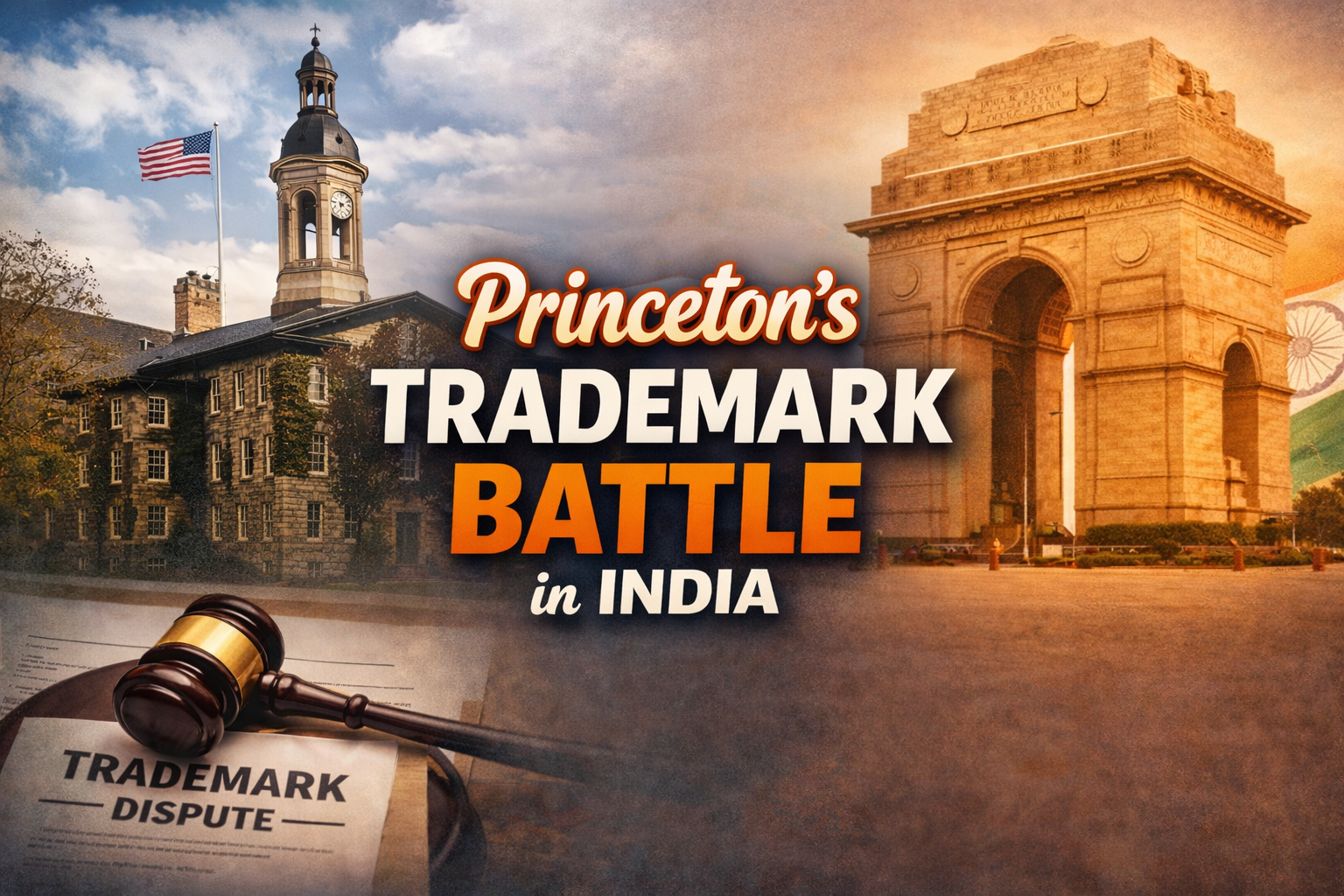
The case is titled The Trustees of Princeton University v The Vagdevi Educational Society & Ors before the Delhi High Court. Princeton University (the “Plaintiff”) claimed ownership of the trademark “PRINCETON” and related marks in India, and alleged that the Telangana-based educational group Vagdevi Educational Society (the “Defendant”) had been using the name “Princeton” (and institutions with that name) since 1991, thereby infringing the mark and passing‐off the Plaintiff’s goodwill.
The Defendant argued that it had adopted the name independently (for local institutions) and claimed prior use in India since 1991, whereas the Plaintiff’s use in India was not shown to be “continuous use” in a domestic sense
KEY ISSUES IN DISPUTE
Some of the major legal issues the Court considered were:
- What constitutes “use” of a mark under Indian law for services (particularly under Section 2(2)(c)(ii) of the Trade Marks Act, 1999). The Court took the view that “use” need not be direct use by the proprietor in India but may include statements about availability/provision of services even through third-parties.
- Trans-border reputation / goodwill: Whether a foreign institution, with no physical presence in India, but known internationally and by Indian students, can claim protection of its mark in India if it can show reputation among Indian consumers. The Court found that reputation and abroad use + Indian students enrolling could suffice for protection.
- Prior users’ rights (Section 34 of the Act): Where a defendant claims they have been using a mark longer in India, this can be a defence. The Court emphasised that the burden lies on the defendant to prove continuous prior use.
- Balance of convenience / equitable factors in granting injunctions: Even when a prima facie case was made out by Princeton University, the Court declined to grant a full injunction immediately because the defendant had a long‐standing use and the plaintiff did not have physical presence, so a limited remedy was crafted.
WHAT THE COURT DECIDED
- The Single Judge of the Delhi High Court initially refused Princeton University an interim injunction, holding that although Princeton enjoyed strong international reputation, it had not shown continuous and substantial use of the mark “PRINCETON” in India. Since the defendant had been using the name since 1991, seemingly in good faith for local operations, the balance of convenience did not favour Princeton.
- “Princeton appealed to the Division Bench, and it was held that it had established a prima facie case of infringement under Section 29, noting evidence of reputation in India (Indian students, media references, etc.). “However, the Bench used its discretion under Section 135 to adjust the relief.”
- Instead of a complete injunction, the Court granted partial relief: the defendant was barred from opening any new institutions under the “Princeton” name during the suit and was directed to submit periodic affidavits of revenue from existing schools.
- The Court reasoned that the defendant’s long-standing use since 1991 and Princeton’s absence of physical presence in India meant that a full injunction would be inequitable at this stage.
REPUTATION: THE POWER AND LIMITS OF A FAMOUS NAME
Princeton’s reputation is beyond question. Its name carries decades of academic excellence, trust, and prestige.
However, the case revealed an important truth: reputation alone doesn’t guarantee total protection. Courts still require proof of consumer confusion or dilution—a clear connection between the use and potential harm.
This approach ensures that trademark act protects reputation without overreaching, maintaining space for legitimate descriptive or comparative use by others. It also reinforces the idea that fame must still meet the fundamental standards of trademark harm.
REMEDIES: WHEN WINNING ISN’T EVERYTHING
Despite winning key arguments, Princeton didn’t receive every remedy it sought. The court issued limited relief, perhaps in the form of an injunction or restrictions on future use, but not full damages or broad prohibitions.
This outcome reflects a growing judicial trend: remedies must be proportionate to the proven harm. Courts are cautious today about granting sweeping injunctions, especially where confusion or damage is minimal.
Princeton’s “partial win” thus becomes a symbol of how modern courts tailor justice to the circumstances, rather than rewarding even strong brands with automatic victories.
RETHINKING REMEDIES IN TRADEMARK ACT
Remedies are often the most contentious part of trademark litigation. Traditionally, successful plaintiffs expect injunctions to halt further use and sometimes seek monetary compensation for damages. However, in this case, the court leaned toward a more equitable remedy, tailoring its response to the demonstrated level of harm.
This evolving perspective aligns with global trends in intellectual property law, where courts are favoring remedies that encourage compliance and education rather than punitive measures. Such proportionality ensures that trademark act remains both effective and fair in protecting brands without stifling legitimate commerce.
BROADER IMPLICATIONS
The implications of this case go far beyond Princeton. For universities, nonprofits, and legacy brands, it signals that even well-known institutions must navigate trademark act with precision. Strong reputation helps, but it doesn’t replace the need for evidence of actual harm or confusion.
For trademark act as a whole, the case underscores three evolving lessons:
- “Use in commerce” is not static—it must adapt to digital and descriptive contexts.
- Reputation matters, but it has limits.
- Remedies should reflect fairness, not brand hierarchy.
CONCLUSION
In the end, Princeton’s partial win highlights how trademark act continues to evolve in balancing global reputation with local rights. The Delhi High Court’s approach reinforces that brand protection is not absolute—it depends on real use, recognition, and fairness. For brand owners and institutions alike, this case is a reminder that strong names must be matched with strategic presence, timely enforcement, and adaptive legal strategy.



Leave a Reply