
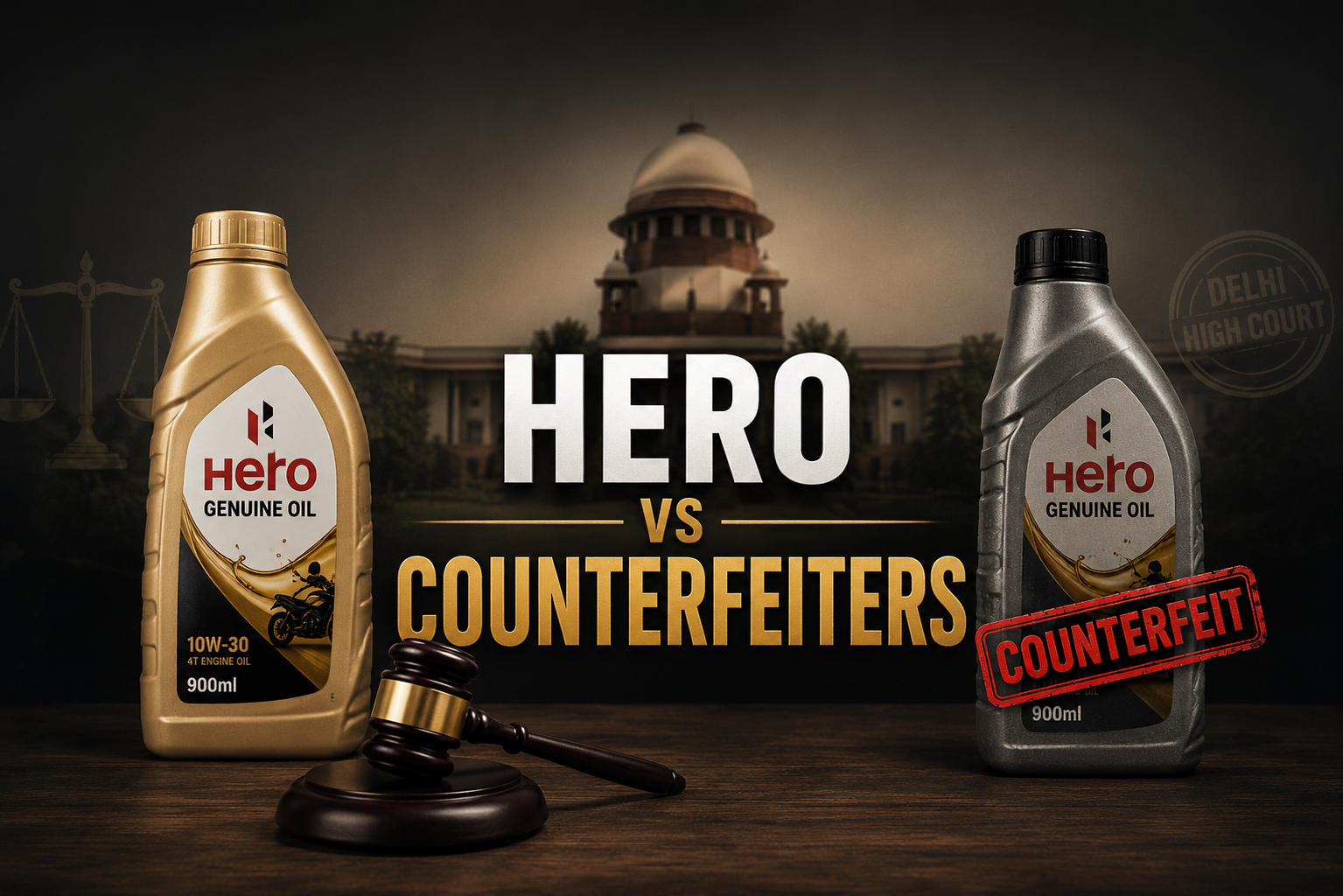
Reinforcement of Hero’s IP Rights: Tackling Counterfeiting Through Design and Trademark Protection
1.Introduction
Counterfeiting remains one of the biggest threats to brand reputation, consumer trust, and market integrity—especially in sectors like automotive lubricants where product quality directly affects safety.
The Delhi High Court’s decision in Hero Investcorp Pvt Ltd & Anr v. Saklin Alias Prince reflects the judiciary’s firm approach towards protecting intellectual property and curbing counterfeit products circulating in the market.
- Case Background
Hero Investcorp Pvt Ltd and its affiliate company are part of the globally recognized Hero Group, owning several registered trademarks for HERO and its device marks. They also hold registered industrial designs for the unique bottle shape used for Hero Genuine Oil.
“The Plaintiffs specifically relied on their registered design numbers 311300 and 311301, asserting that the Defendant’s counterfeit bottles were clear imitations, resulting in infringement of the suit designs.”
In early October 2025, Hero discovered that the Defendant— Saklin Alias Prince —was allegedly manufacturing and distributing counterfeit engine oil bottles that:
- Copied Hero’s registered bottle design
- Used the HERO mark or deceptively similar labels
- Closely resembled the genuine Hero Genuine Oil packaging
- Were being manufactured from industrial premises in Delhi
Photographs, samples, and on-ground investigations highlighted a well-organized setup aimed at deceiving consumers and exploiting Hero’s goodwill. Fearing destruction of evidence and further consumer harm, the Plaintiffs approached the Delhi High Court seeking urgent ex-parte interim relief.
“The Plaintiffs also emphasized their extensive global trademark portfolio, noting that Plaintiff No. 1 and its group companies currently own over 2,000 registrations and applications for the mark ‘HERO’ across 121 countries worldwide.”
This case was heard by the Delhi High Court on 10 October 2025 as a commercial suit under the Commercial Courts Act in Hero Investcorp Pvt Ltd & Anr v. Saklin Alias Prince.
- Statutory Provisions Invoked
Hero’s claims rested on the following legal provisions:
Hero’s claims were grounded in multiple statutory provisions. Under the Trade Marks Act, 1999, the Plaintiffs relied on Sections 29(1), 29(2)(b) and 29(3) to assert infringement on account of the Defendant’s use of identical and deceptively similar marks, as well as Section 29(4) for dilution and unfair advantage. Jurisdiction was invoked under Section 134, and remedies such as injunction and seizure were supported by Section 135. In addition to trademark rights, Hero also invoked Section 22 of the Designs Act, 2000, which addresses piracy of registered designs, given that the bottle shape was a registered design. The Plaintiffs further sought exemption from pre-institution mediation by relying on Section 12A of the Commercial Courts Act, 2015, citing exceptional urgency. Beyond statutory law, Hero also asserted the common law remedy of passing off, arguing that the Defendant’s actions amounted to misrepresentation capable of confusing consumers and harming the brand’s goodwill.
- Plaintiffs’ Arguments & Need for Urgency
Hero argued that the case required urgent judicial intervention because:
- Counterfeiters typically conceal or destroy goods if prior notice is given.
- Fake engine oil poses serious safety risks to consumers and vehicles.
- Continued sale would lead to irreparable harm to Hero’s goodwill.
- The scale of operation indicated a commercially motivated counterfeiting network.
Accordingly, Hero sought:
- An ex-parte injunction
- Seizure of infringing goods
- Appointment of a Local Commissioner to raid and secure evidence
- Waiver of pre-institution mediation
- Court’s Findings
Justice Anish Dayal of the Delhi High Court found the following:
The Court observed that Hero had established a strong prima facie case, noting that the Defendant’s products were almost identical copies of Hero’s trademarked bottles and labels, clearly designed to mislead an average consumer.
“The Court’s observations highlighted Hero’s substantial market reputation and strong consumer recognition. This established goodwill strengthened the finding that even minor similarities in the Defendant’s products were likely to mislead consumers and unfairly take advantage of Hero’s brand value.”
It further held that the Plaintiffs faced a serious threat of irreparable harm, as counterfeit lubricants could not only damage vehicles and compromise consumer safety but also severely diminish the reputation and goodwill of a trusted automotive brand—losses that could not be adequately compensated through monetary damages. The balance of convenience also lay firmly in Hero’s favour, with the potential risk to consumers and brand integrity far outweighing any inconvenience to the Defendant. Additionally, the Court found exceptional circumstances justifying ex-parte relief, as prior notice could have resulted in the concealment or destruction of infringing goods, warranting the bypass of mediation and the grant of urgent interim protection.
- Court’s Directions
The Court granted wide-ranging and immediate protection to the Plaintiffs:
- Ex-Parte Ad-Interim Injunction
The Defendant was restrained from manufacturing, selling, distributing, or offering any products—online or offline—bearing the Hero trademark or using packaging identical or deceptively similar to Hero’s registered designs.
- Appointment of Local Commissioner
A Local Commissioner was appointed with powers to:
- Visit the Defendant’s premises without notice
- Inspect and seize counterfeit goods
- Prepare an inventory
- Photograph the premises
- Seize packaging, moulds, labels, and materials
- Review books of account
This ensured that evidence was preserved and no counterfeit products leaked further into the market.
- Legal Principles Highlighted
This case underlines several important principles in IP enforcement:
- Trademark and design rights can be enforced simultaneously to create stronger protection.
- Counterfeiting is treated as aggravated infringement because it endangers consumer safety.
- Ex-parte injunctions are justified where there is a real risk of evidence destruction.
- Visual similarity alone is sufficient at the interim stage—intention need not be proved.
- Courts prioritize consumer protection and brand trust over procedural delays.
- Why the Case Matters: Lessons for Businesses
This judgment is significant for all industries dealing with counterfeiting, especially automotive, FMCG, electronics, cosmetics, and pharmaceuticals.
- Courts Are Proactive in Brand Protection
Strong IP ownership combined with credible evidence can result in immediate judicial protection.
2. Design Registration Is Highly Valuable
Registered bottle shapes played a crucial role in securing relief—businesses should register their packaging designs proactively.
3.Consumer Safety Is a Priority
Counterfeit engine oil poses real dangers; the Court’s strict approach will deter similar offenders.
4. Importance of Market Surveillance
Hero’s well-documented investigation, photographs, and samples strengthened the case.
5. Ex-Parte Relief Is Possible with Proper Evidence
Courts are willing to act swiftly when brand reputation and public safety are at stake.
- Conclusion
The Delhi High Court’s ruling in Hero Investcorp Pvt Ltd & Anr v. Saklin Alias Prince reaffirms India’s firm stance against counterfeiting. By granting an ex-parte injunction and authorizing seizure of fake goods, the Court sent a clear message: counterfeiters misusing established brand reputations and risking consumer safety will face immediate and decisive legal action.
For businesses, the case highlights the importance of robust IP protection, continuous market monitoring, and timely legal intervention to safeguard reputation and maintain consumer trust.


Leave a Reply