
INTRODUCTION
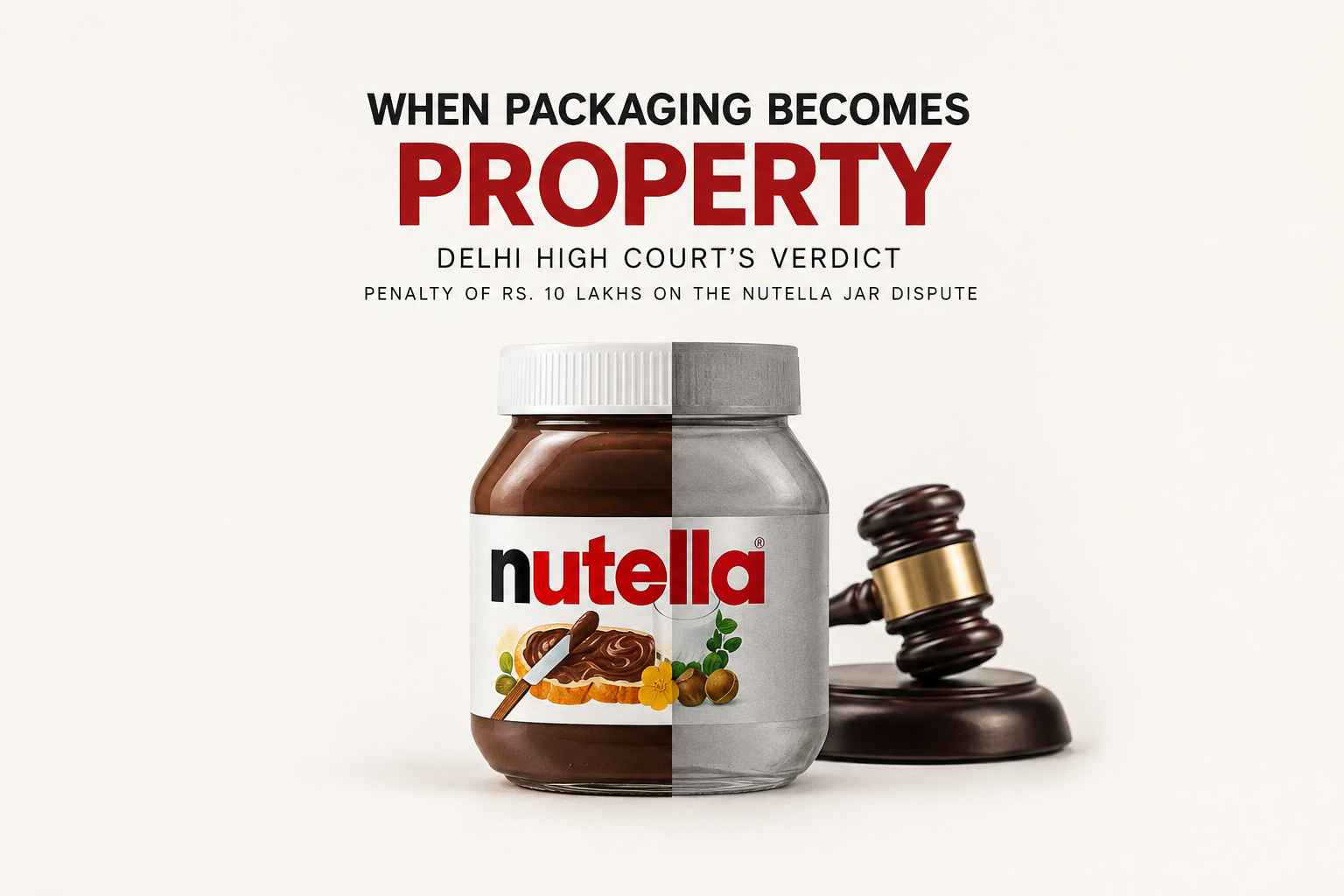
On 19 November 2025, the High Court of Delhi delivered a significant judgment in Ferrero Spa & Ors. Vs. Abhimanyu Prakash & Ors. (CS(COMM) 65/2023), in which it permanently restrained a set of Firozabad-based glass manufacturers from producing and selling empty glass jars deceptively similar to the registered Nutella jar shape. The Court also ordered the delivery of over 3.05 lakh such jars to the plaintiffs and imposed costs of Rs. 10 lakhs on the defendants. The ruling reaffirms the robust protection accorded to shape marks and trade dress under Indian intellectual property law, emphasizes the serious consequences of facilitating counterfeiting, and provides key jurisprudential guidance on awarding ancillary relief such as costs and delivery up of infringing stock and highlights the intricate dynamics between brand protection and counterfeiting concerns in the 21st century.
BACKGROUND TO THE DISPUTE
The plaintiff in this suit was Ferrero Spa & Ors., the multinational Italian company iconic for its hazelnut cocoa spread marketed under the Nutella brand. Ferrero’s products enjoy immense popularity worldwide, and the company has, over decades, invested substantially in building an unmistakable brand identity not merely in terms of name and logo, but also in the distinctive contours and configuration of its glass jars. The plaintiff’s proprietary rights in this unique shape mark have been duly registered under the Trade Marks Act, 1999 and recognized as integral to its trade dress. On the opposing side were manufacturers based in Firozabad, Uttar Pradesh, a region historically known for its glass industry. These defendants were engaged in the commercial production and sale of empty glass jars that, on prima facie view, bore close resemblance to the well-known Nutella jar design. Their products were offered for sale online including on platforms like IndiaMart and marketed under descriptions such as “Nutella glass jars”.
CORE LEGAL ISSUES BEFORE THE COURT
Ferrero’s claim was rooted in trademark infringement, passing off, and trade dress misappropriation essentially asserting that the defendants, by manufacturing and selling containers that mimicked the shape and design of the globally recognized Nutella jar, were engaging in unlawful exploitation of its proprietary rights. Importantly, Ferrero underscored that this was not a mere dispute over colours or logos; it was about a three-dimensional shape mark that the company had cultivated and registered over decades, giving it legal protection against unauthorized imitation. The defendants countered by asserting that they were merely producing generic glass jars and that, in trade parlance, the term “Nutella jar” was used loosely to describe a particular jar silhouette. They further denied any involvement in the counterfeit final product market, distancing themselves from claims that their jars were being used to package fake Nutella spreads.
PROCEDURAL MARCH THROUGH THE COURTS
Ferrero initiated its suit as CS(COMM) 65/2023, seeking multiple forms of relief most crucially, a permanent injunction prohibiting the defendants from making, selling, or offering to sell the infringing jars, along with ancillary remedies such as delivery up of infringing stock, damages, and costs. Early in the proceedings, the court granted ex-parte interim injunctions in February 2023, effectively halting the defendants’ operations pending further adjudication. As the case advanced, the defendants filed written statements but subsequently conceded to the plaintiffs’ proprietary rights in the Nutella jar shape mark and did not contest the permanent injunction. With mediation attempts failing and the factual matrix largely uncontested regarding the similarity of the jars, the dispute shifted principally to quantum of remedies specifically, whether the situation justified the award of damages in addition to injunction, and whether the imposition of costs was appropriate.
EVIDENCE, COMMISSIONER’S ROLE, AND FACTUAL FINDINGS
The court appointed Local Commissioners who conducted physical inspections of the defendants’ premises, ultimately seizing 3,05,916 jars that were determined to be deceptively similar to the Nutella jar design. These jars came in standard sizes (including 350 ml and 650 ml variants), and importantly, some bore embossing and promotional literature explicitly referring to them as Nutella-type jars facts which materially undercut any defense of ignorance or generic usage. Ferrero also presented documentary evidence, including emails and design brochures where the jars were labeled as “Nutella cocoa jar”, demonstrating that the defendants were at least constructively aware of the brand identity they were imitating. The cumulative effect of this evidence was that the court concluded the defendants’ conduct could not be shrugged off as accidental or innocuous it was a knowing infringement.
THE HIGH COURT’S LEGAL REASONING
In its analysis, the Delhi High Court underscored several established principles of intellectual property law:
- Shape Marks and Trade Dress Are Protectable: Not only names and logos but also non-functional shapes that have acquired distinctiveness in the marketplace are entitled to legal protection. The Nutella jar was held to enjoy such distinctiveness through sustained global usage and recognition.
- Deceptive Similarity and Consumer Confusion: The resemblance of the defendants’ jars to Ferrero’s design was so substantial that it risked confusing consumers and diluting the brand’s trade identity, even if the jars were empty at the point of sale.
- Knowing Infringement Defeats Innocence Claims: The evidence of promotional labels and design communications reflecting specific intent to emulate Nutella packaging negated any claim of innocent or first-time infringement. While the defendants attempted to position themselves as mere manufacturers of generic containers, the court found the context and conduct demonstrative of deliberate copying.
- Balancing Remedies: While Ferrero sought damages in excess of Rs. 53 crores, the court observed that this figure lacked specific evidentiary underpinning relating to actual sales of counterfeit products by the defendants themselves. In the absence of such proof, awarding exaggerated compensatory damages could be disproportionate. Hence, the court adopted an equitable approach by imposing Rs. 10 lakhs as costs and ordering the handover of infringing jars.
THE FINAL ORDER AND ITS CONSEQUENCES
The Delhi High Court thus issued a final decree in favor of Ferrero with the following operative directions:
Permanent Injunction: The defendants were restrained from manufacturing, offering for sale, selling, or dealing in any jars resembling the Nutella shape mark.
Handover of Inventory: All 3,05,916 seized jars were ordered to be delivered to the plaintiff within two weeks giving Ferrero the liberty to use, repurpose, or even fill them for charitable distribution under its Corporate Social Responsibility initiatives.
Costs: The defendants were directed to pay Rs. 10 lakhs towards legal costs a sum reflective of court fees, commissioners’ expenses, and the judicial process required to vindicate Ferrero’s rights.
Destruction of Ancillary Materials: All other promotional or packaging materials that facilitated infringement were ordered to be destroyed under supervision.
Importantly, the court refrained from awarding punitive or exemplary damages of the magnitude sought by Ferrero, striking a balance between deterrence and fairness.
CONCLUSION
The Nutella jar controversy in the Delhi High Court is a compelling example of how intellectual property law adapts to novel contexts extending protection beyond flat trademarks to encompass three-dimensional shapes crucial to brand identity. It underscores the judiciary’s willingness to temper rigid doctrine with equitable remedies, ensuring that rights are vindicated without excessive punishment where evidence warrants moderation. Read together, this judgment marks another step in the evolution of India’s IP jurisprudence one that balances innovation, competition, and consumer protection in an increasingly brand-driven economy.


Leave a Reply