
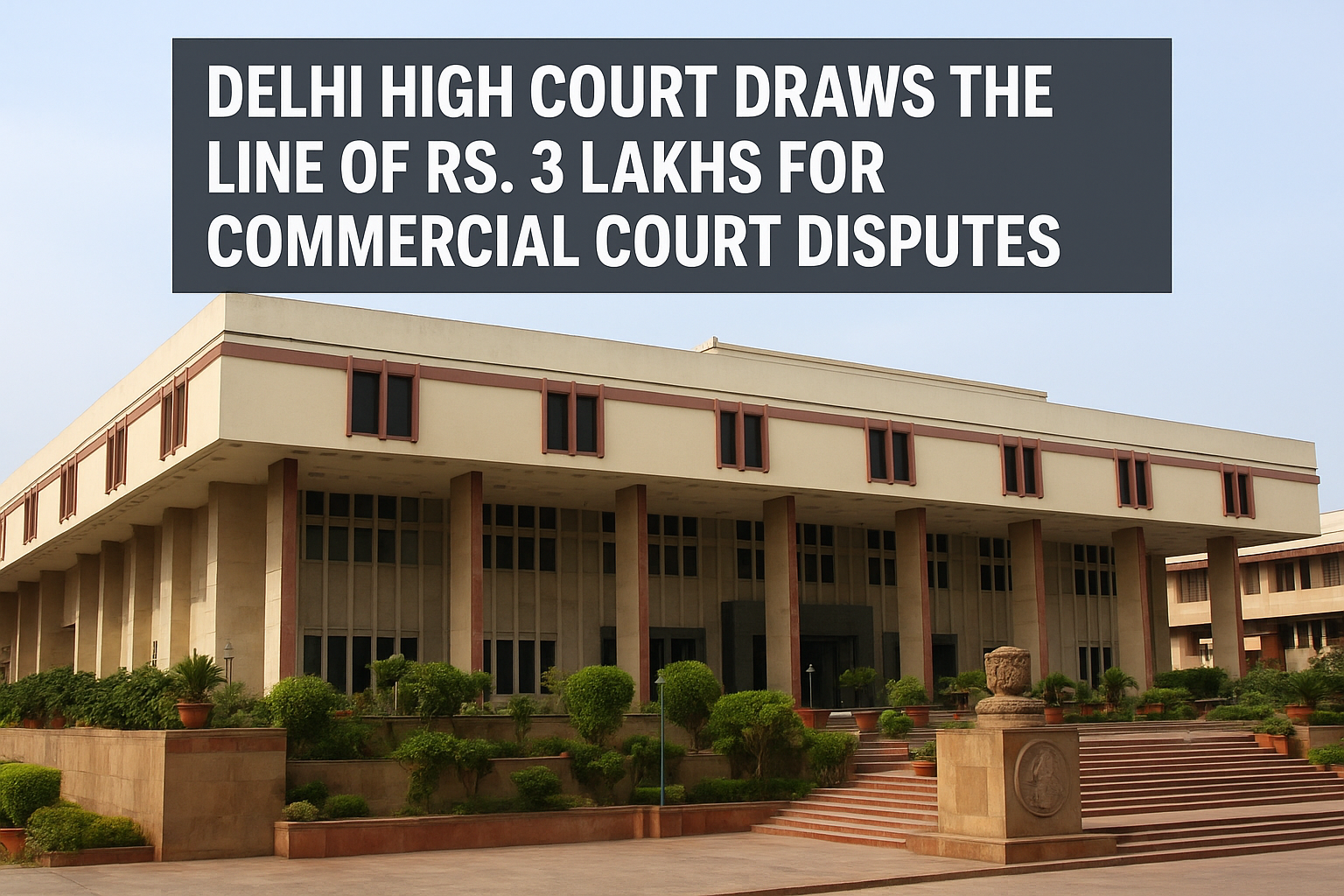
DELHI HIGH COURT DRAWN THE LINE OF RS. 3 LAKHS FOR COMMERCIAL COURT DISPUTES
INTRODUCTION
In a landmark decision, the Delhi High Court has resolved a significant issue in the realm of intellectual property (IP) litigation in India the practice of undervaluing claims to avoid being routed through commercial courts. The Court has now unequivocally stated that all IP disputes, regardless of the monetary value assigned to them, must be heard by Commercial Courts as mandated. This decision marks a pivotal moment in intellectual property litigation. It ensures that intellectual property suits are no longer undervalued to escape the jurisdiction of commercial courts, which are better equipped to handle complex, high-staking commercial matters. Going forward, this judgment will have widespread implications for how IPR (Intellectual Property Rights) cases are filed, how their value is determined, and how they are ultimately adjudicated across the country. The Delhi High Court has condemned this tactic as forum shopping and ruled that all IP disputes regardless of their stated monetary value must be brought before commercial courts under the Commercial Courts Act, 2015. This ensures consistency, efficiency, and proper adjudication of IP cases.
THE VISHAL PIPES CASE: A TURNING POINT
In early 2022, Vishal Pipes Pvt. Ltd., a company with significant market presence and turnover running into crores, filed a legal suit in Delhi against Bhavya Pipe Industry, alleging trademark and copyright infringement disputes that typically fall within the ambit of commercial litigation. However, what drew attention was the unusually low valuation Vishal Pipes assigned to its legal reliefs, such as injunctions and damages merely rupee 200 or 1,000. The claim did not meet the Rs. 3,00,000/- (three lakh rupees) threshold mandated by the Commercial Courts Act, 2015, for adjudication by a commercial court. Under Indian civil procedure, plaintiffs must assign a monetary value to the reliefs sought, which determines the court fee. By undervaluing its claim, Vishal Pipes significantly reduced its court fee liability. This is a known strategy in litigation, especially when the plaintiff prioritizes injunctive relief over monetary compensation. However, given the high commercial stakes, such undervaluation raises concerns of procedural abuse.
The Commercial Courts Act was enacted to streamline and expedite commercial disputes, including those related to intellectual property. By pegging the relief value below the statutory threshold, Vishal Pipes appears to have circumvented the commercial court system, potentially to avoid stricter timelines, mandatory pre-institution mediation, or closer judicial scrutiny. This move invites questions about the genuineness of the stated claim value. Courts today are increasingly alert to such tactics. If they find the valuation to be artificial, they may direct reassessment of the suit’s value, require payment of the appropriate court fee, or even transfer the case to a commercial court. Moreover, deliberate undervaluation can undermine the credibility of the plaintiff’s claims and may be viewed as a misuse of the judicial process aimed at securing a quick injunction against a competitor. In essence, while the approach adopted by Vishal Pipes might offer short-term procedural convenience, it raises broader concerns about fairness and forum-shopping in commercial litigation. The case highlights the ongoing tension between legal economy and the integrity of judicial forums in India’s evolving commercial dispute landscape.
COMMERCIAL NATURE OF IPR SUITS AND JURISDICTIONAL DIVIDE
All Intellectual Property Rights (IPR) cases are essentially civil disputes. However, with the introduction of the Commercial Courts Act, 2015 (CCA), they are now officially treated as ‘commercial disputes’ under Section 2(c)(xvii) of the Act. Despite their classification, IPR suits must still be filed in District Courts, as required by the specific laws governing intellectual property. In Delhi, before the CCA came into effect, IPR cases were handled either by District Judges or the High Court, depending on the value of the case. But things changed after the CCA and further judicial changes in 2018 and 2019. Now, there are three separate judicial levels for IPR cases based on how much money is involved:
- Below Rs. 3,00,000: Handled by Non-Commercial District Judges
- Rs. 3,00,000 to Rs. 2 crores: Handled by Commercial District Judges
- Above Rs. 2 crores: Handled by the High Court’s Commercial Division
This structure has created an inconsistency. Even though all IPR cases are considered commercial, those valued under Rs. 3,00,000/- don’t benefit from the special, faster procedures laid out in the CCA like case management hearings and summary judgments.
This goes against the main goal of the CCA, which was to ensure that all commercial disputes including IPR matters are resolved in a quick, efficient, and consistent manner, regardless of how much money is at stake.
THE JOURNEY OF A LEGAL CASE: COMMERCIAL VS. NON-COMMERCIAL
Commercial and non-commercial cases follow different procedures. In commercial cases, mediation before filing the case is mandatory to encourage settlement. The plan must be filed with a specific format including a Statement of Truth and a declaration under Order VI Rule 15A. The written statement must be submitted within 120 days strictly; late filing is generally not allowed. Documents and any additional evidence must comply strictly with Order XI rules, and late submissions require court permission. Commercial cases have a case management hearing to set timelines and speed up the process. If it’s clear that a party has no valid defense, the court can pass a summary judgment to dispose of the case quickly. Costs are often awarded against the losing party, including damages and legal fees. Witness examination happens as directed by the court. Appeals must be filed within 60 days. In contrast, non-commercial cases have more flexible rules and timelines.
LEGAL IMPLICATIONS: WHAT THIS MEANS FOR IP OWNERS AND LAWYERS
The recent ruling carries significant legal implications for intellectual property owners and their legal representatives. IP owners are now required to value their claims honestly and realistically, reflecting the true commercial impact of the dispute rather than artificially low amounts to circumvent jurisdictional thresholds. Legal advisors play a crucial role in guiding their clients to select the appropriate forum and must discourage any attempts to use procedural shortcuts, such as undervaluing claims to avoid Commercial Court jurisdiction. Courts have assumed a more proactive stance and will scrutinize the valuation of claims closely, with the authority to transfer cases to Commercial Courts even if the plaintiff’s stated claim value suggests otherwise. As a result, lawyers must be prepared to present more comprehensive and rigorous documentation and evidence, especially when seeking urgent remedies like injunctions. Overall, this ruling elevates the standards for both strategic planning and ethical conduct in intellectual property litigation, ensuring greater fairness and judicial oversight.
CONCLUSION
The recent ruling by the Delhi High Court represents a significant advancement in strengthening intellectual property enforcement in India. By affirming that all IP disputes are inherently commercial in nature, the Court has underscored the importance of examining the true commercial value of claims rather than relying solely on the plaintiff’s stated figures. This approach effectively curtails forum shopping, where parties might otherwise undervalue claims to avoid specialized Commercial Courts. It also ensures that cases are heard by courts with the requisite expertise, promoting more informed and consistent adjudication. For businesses, rights holders, and legal practitioners, this ruling signal a decisive shift: intellectual property disputes must be addressed with the commercial gravity they warrant and cannot be trivialized as ordinary civil matters. In doing so, the judgment aligns Indian IP enforcement with international standards, fostering greater protection of rights and encouraging a more robust and efficient legal framework for intellectual property disputes.



Leave a Reply