INTRODUCTION
Yatra.com is one of India’s leading online travel agencies, known for providing a range of travel-related services including flight and hotel bookings, holiday packages, bus and train reservations, and more. While the company has built a strong brand over the years, recent legal developments have highlighted an interesting challenge — the difficulty of protecting a brand name that is also a common word.
THE ORIGIN AND RISE OF YATRA.COM
Yatra.com was founded in 2006 by Dhruv Shringi, Manish Amin, and Sabina Chopra. With a vision to simplify travel planning for Indian customers, Yatra quickly became a go-to portal for booking domestic and international travel. The name “Yatra” — meaning “journey” or “travel” in Hindi — resonated deeply with Indian audiences, giving the brand an instant cultural connect.
Over the years, Yatra grew into a major player in the Indian travel industry. As of FY 2023–24, the company reported a turnover of over ₹5,600 crore and served more than 15 million customers. Its wide recognition and customer base made “Yatra.com” a household name for travel services in India.
THE LEGAL BATTLE: YATRA VS. BOOKMYYATRA
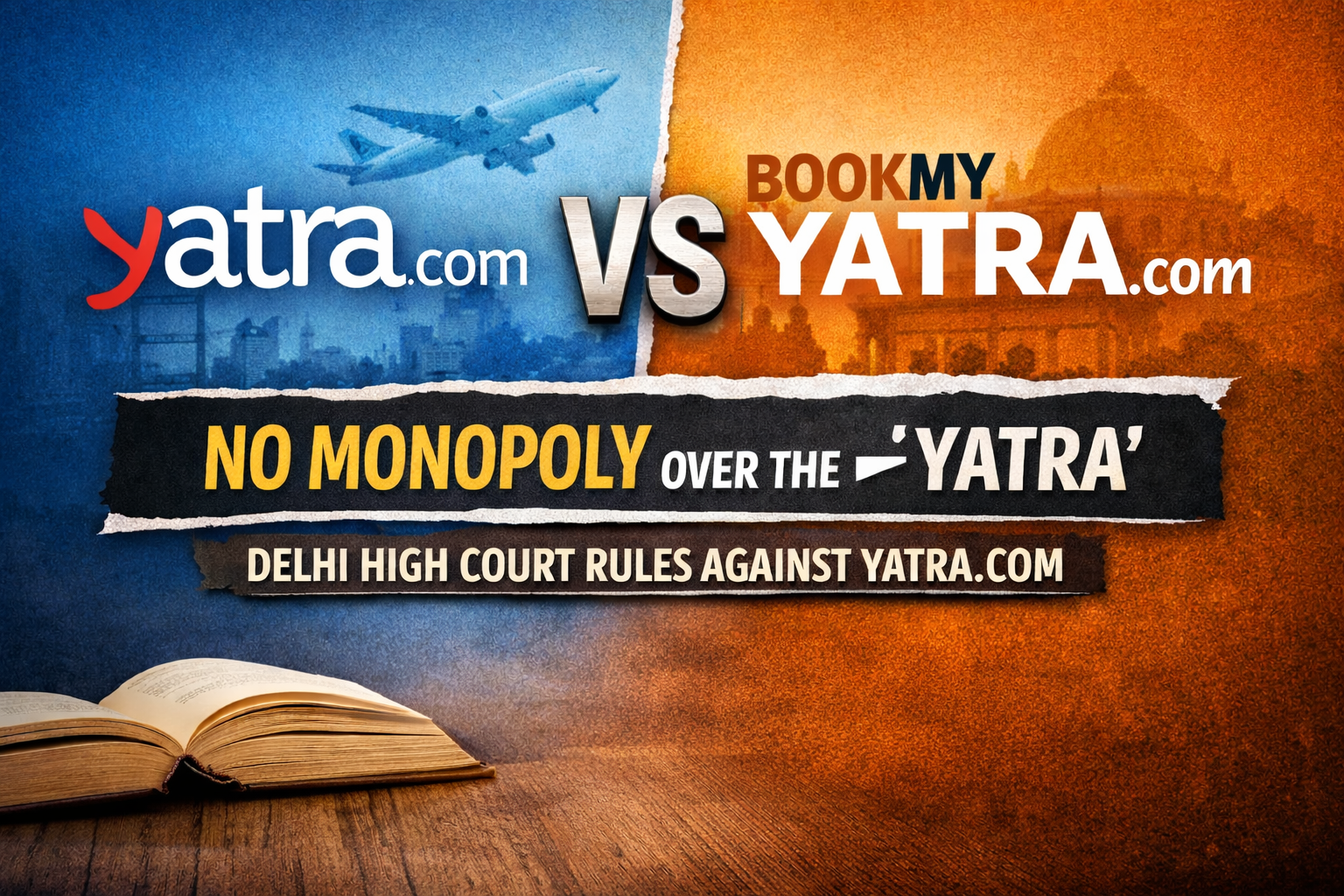
In early 2024, Yatra Online Ltd. filed a lawsuit against Mach Conferences & Events Ltd., which was using the domain and brand name “BookMyYatra.com.” Yatra argued that the use of “Yatra” in this competing brand created confusion among consumers and amounted to trademark infringement and passing off.
However, the defendants responded by pointing out that “Yatra” is a commonly used word for travel and that Yatra.com had registered its trademarks with a disclaimer. They argued that the use of the term “BookMyYatra” was not misleading, as it was sufficiently different and descriptive in nature.
The Plaintiff initially obtained an ex-parte interim injunction restraining the Defendant from using the impugned marks until it was set aside on August 22 2025.
On August 22, 2025, the Delhi High Court ruled in favor of the defendants, stating that “Yatra” is a generic term that cannot be monopolized by a single company. The Court noted that Yatra’s trademarks included disclaimers and that the word did not have enough distinctiveness to be protected in isolation. The suit was allowed to proceed, but no restraining orders were passed. As a result, the Court refused to grant an injunction against the use of “BookMyYatra.com” and dismissed Yatra’s claims.
WHY THE COURT SAID NO: GENERIC WORDS AND SECONDARY MEANING
This case sets an important precedent. Under trademark law, generic or descriptive terms (like “Yatra” for travel) cannot be registered or protected unless they have acquired what is known as secondary meaning. This means the word must be so widely associated with one brand that the public recognizes it as uniquely representing that company.
Section 9(1)(b) of the Trade Marks Act, 1999 lays down the absolute grounds for refusal — marks that are descriptive or devoid of distinctiveness cannot be registered. The Court applied this principle, observing that “Yatra” merely describes the service itself and hence lacks distinctiveness.
Yatra argued that it had built such a reputation, but the Court found this insufficient. It emphasized that generic terms must remain available for all businesses to use, especially in highly competitive industries like travel. The Court also pointed out that adding “.com” or “BookMy” does not automatically make the mark distinctive.
The Court therefore concluded that no prima facie case of infringement or passing off was made out to justify an interim injunction.
COURT ANALYSIS AND FINDINGS
The Yatra.com judgment reinforces several key principles of trademark law in India:
- Generic and Descriptive Marks Cannot Be Owned Exclusively -Words that describe the nature or type of service (like “Yatra” for travel) cannot be registered exclusively, as this would prevent competitors from using language that fairly describes their own offerings. This principle flows directly from Section 9 of the Act.
- Secondary Meaning is Crucial -A descriptive term can gain protection only if it acquires a secondary meaning that consumers associate it uniquely with one company. Yatra.com failed to establish this, as “Yatra” continues to be used widely in the travel sector.
- Disclaimers Restrict Trademark Rights -When a registration carries a disclaimer (for example, “no exclusive right over the word Yatra”), it legally limits the owner’s ability to enforce exclusivity over that word. This also impacts the scope of rights under Section 28 of the Act, which grants exclusivity only subject to other provisions and disclaimers.
- Composite Marks Must Be Viewed as a Whole -Under Section 17(2), trademark rights apply to the mark as a whole, Courts assess the likelihood of confusion based on the mark as a whole. “BookMyYatra” and “Yatra.com”, though sharing a word, are visually and conceptually distinct enough to coexist.
IMPACT OF THE JUDGMENT
- The Delhi High Court’s ruling serves as a crucial precedent for Indian businesses using descriptive brand names. For Yatra.com, the decision means that while it can still protect its overall brand identity, logo, and reputation, it cannot stop others from using “Yatra” in a descriptive sense or as part of another brand name.
- For other startups and digital platforms, the case highlights the risks of adopting common words as trademarks. While such names may seem relatable and easy to market, they often lack the distinctiveness required for strong IP protection.
- This ruling also underlines the importance of strategic trademark registration — ensuring that companies protect their composite marks, visual elements, and unique identifiers (like taglines or logos), which offer stronger legal footing.
PARALLEL CASES IN INDIAN TRADEMARK LAW
The Yatra.com decision aligns with previous rulings where courts denied exclusivity over descriptive terms. For instance, in Info Edge (India) Ltd. v. Shailesh Gupta (Naukri.com case), the Delhi High Court held that “Naukri” (meaning “job”) was descriptive for employment services. Similarly, MakeMyTrip (India) Pvt. Ltd. v. Orbit Corporate & Leisure Travels (India) Pvt. Ltd. highlighted that even strong online brands must show acquired distinctiveness to claim protection over common words. These cases collectively reinforce that descriptive or generic terms — even when used with “.com” — are weak trademarks unless supported by substantial secondary meaning.
CURRENT STATUS
It was concluded that Yatra had failed to establish a prima facie case, the court dismissed the injunction application and vacated the interim order dated 9 December, 2024. The judgement allows Mach Conferences and Events Limited to use the marks “BOOKMYYATRA” & “BOOKMYYATRA.COM” for its business. This ruling serves as a crucial reminder for businesses about the limitations of trademark protection of generic and descriptive words.
CONCLUSION
- The Yatra.com case is a landmark example of how even powerful brands face limitations when using generic terms. The Delhi High Court’s decision in Yatra Online Ltd. v. Mach Conferences & Events Ltd. reaffirms that no entity can monopolize words that form part of everyday language.
- For businesses and brand owners, the takeaway is clear — distinctiveness is the foundation of trademark protection. In the competitive digital space, a creative and legally sound branding strategy is just as essential as innovation and customer trust. Yatra.com’s legal “journey” reminds us that every name has meaning — but only a distinctive one earns exclusive rights.


Leave a Reply