
INTRODUCTION
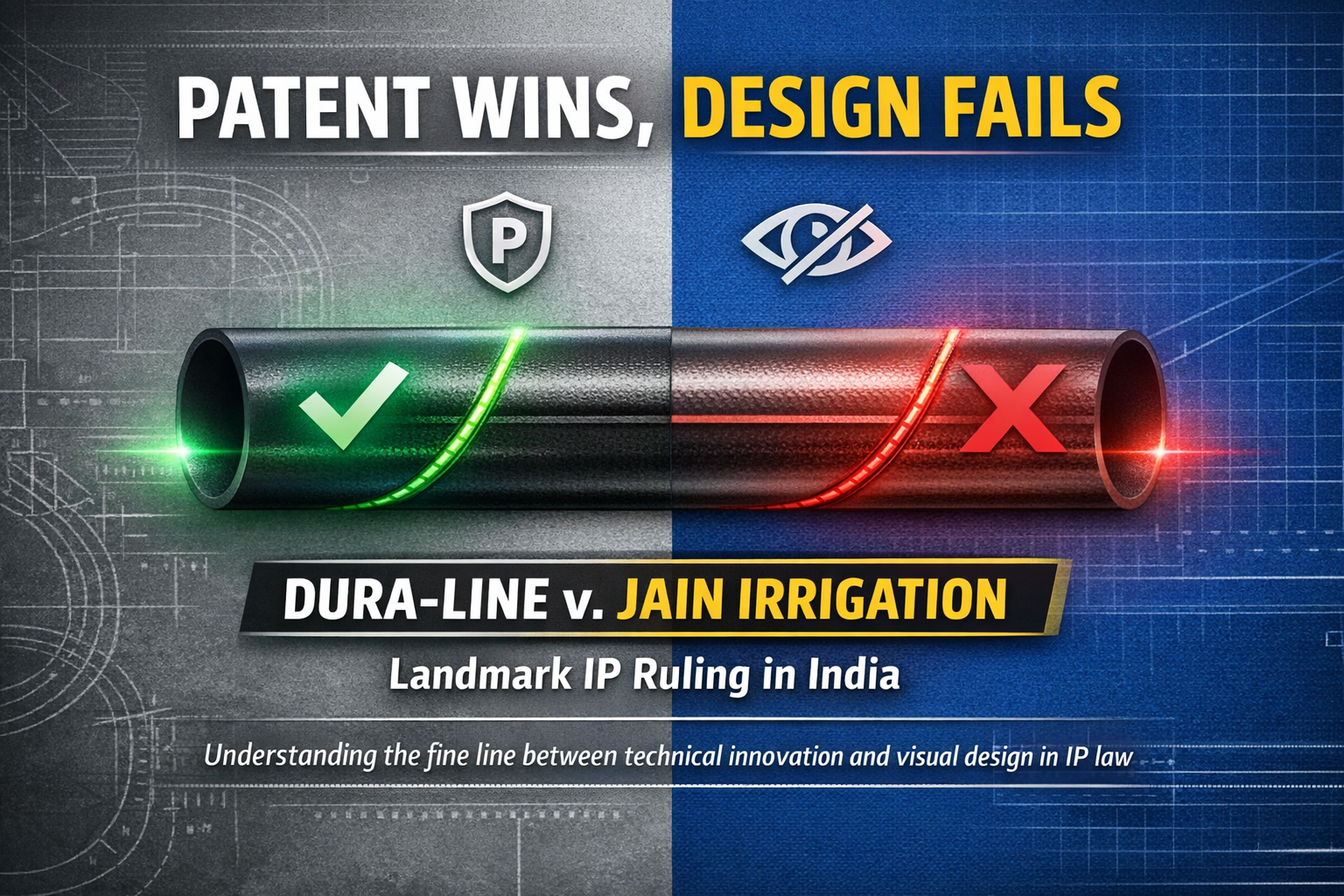
This is the story of a long-running intellectual property dispute in India between Dura-Line India Pvt. Ltd. (a subsidiary of the U.S. infrastructure company) and Jain Irrigation Systems Ltd. The dispute concerned patents and design rights over non‐metallic pipes with embedded tracer cables for leak detection and underground traceability. On 19 May 2025, the Delhi High Court delivered a landmark ruling upholding the patent claim but rejecting the design claim.
FACTUAL & TECHNICAL BACKGROUND
The Parties
-
- Dura-Line India Pvt. Ltd. is a wholly owned subsidiary of Dura-Line International, which specializes in infrastructure solutions (conduits, cable in conduit, water and communication pipes).
- Jain Irrigation Systems Ltd. (JISL) is a major Indian manufacturer of plastic pipes, including PVC, PE, PP, and related irrigation / water infrastructure lines.
THE INVENTION / PATENT
- The patent in question is Indian Patent No. IN 199722 titled “A Pipe Assembly Having Traceability and Leakage Detection Features”.
- Its key feature is a non-metallic pipe whose outer surface has a co-extruded tracer cable (encased in polymer) that can transmit pulses, enabling underground traceability and leak detection.
- The product was marketed by Dura-Line under the brand “Dura Trac”.
- The patent application was filed (as No. 927/DEL/2003) and was granted on 30 August 2007.
- The patent had a life of 20 years from the date of application, meaning it expired in July 2023.
DESIGN REGISTRATION
In addition to patent protection, Dura-Line held Design Registration No. 192665 for a “detectable pipe” (a pipe having a co-extruded cylindrical structure). The design registration allegedly covered the surface pattern of the pipe specifically, how the tracer cable is integrated in a visible pattern on the pipe surface.
Under Section 2(d) of the Designs Act, 2000, a “design” refers to the features of shape, configuration, pattern, ornament, or composition of lines or colors applied to an article that appeal to the eye, provided they are not purely functional. Dura Line’s registration therefore sought to protect the aesthetic arrangement or appearance of the tracer cable on the pipe surface, as opposed to its functional or technical aspect (which was separately protected under the patent). The registration was valid for an initial period of 10 years, extendable by 5 years under Section 11 of the Designs Act. Dura Line’s objective was to secure dual IP protection patent for the technical innovation and design for the visual configuration to prevent competitors from manufacturing pipes with a similar visible tracer integration pattern.
THE TRIGGER / CONFLICT
- In 2011, there was a tender for the Omkareshwar Lift Irrigation Scheme, which required HDPE pipes with an underground detectability feature (i.e. with a co-extruded copper wire/tracer). Dura-Line responded to that tender.
- Subsequently, an article in the Hindustan Times (11 December 2012, Indore edition) reported that Jain Irrigation claimed to have already supplied tracer pipes for that project.
- Dura-Line, upon discovering this, initiated legal proceedings claiming that Jain Irrigation’s products (“B-Sure PE/PP Sewerage Pipes” and “Jain Insta Tracer Pipes”) infringed Dura-Line’s patent and design.
VALIDITY OF PATENT (COUNTERCLAIM)
- Jain Irrigation challenged the patent under multiple limbs of Section 64(1) (novelty, inventive step, sufficiency of disclosure, fraud). The court scrutinized prior art references and the specification to see whether the claimed combination (co-extruded tracer cable on a nonmetallic pipe, encased in polymer) was obvious or anticipated.
- The court found that the objections were not made out: The specification was sufficiently enabling; the court rejected insufficient disclosure arguments. The inventive step objection was dismissed; the court held the claimed combination was not obvious merely by “mosaicing” prior art references. – Fraud allegations were found unsubstantiated.
Therefore, the patent was held valid, and the counterclaim for revocation was dismissed.
INFRINGEMENT OF PATENT
- Having upheld validity, the court compared Claim 1 of the patent with the features of Jain’s products (B-Sure PE/PP Pipes, Jain Insta Tracer) to see if they contain all essential elements. Although Jain tried to argue that their technique was not true co-extrusion (i.e., they affixed tracer cable after extruding), Dura-Line submitted evidence that core features were adopted.
- Under Section 48 of the Patents Act, 1970, a patent confers upon the patentee the exclusive right to prevent third parties from making, using, offering for sale, selling, or importing a product that falls within the scope of the patented claims. The court emphasized that infringement is assessed by comparing the claimed invention with the impugned product, not by analyzing differences in the manufacturing method or terminology used by the alleged infringer.
- The court also referred to Section 104A of the Patents Act, which allows for a reversal of the burden of proof in certain infringement cases involving process patents. While the present case concerned a product patent, the court noted that once Dura Line had demonstrated substantial similarity and commercial use, the evidentiary burden shifted to Jain to prove non-infringement something Jain failed to establish through credible technical evidence.
- The court held that Jain’s products did infringe Claim 1 (and dependent claims) in substance. The court clarified that infringement is to be judged by what the product embodies, not merely by the manufacturing steps or label differences.
Thus Issue (iii) (infringement) was held in favor of Dura-Line.
INFRINGEMENT OF DESIGN
- The designs claim was more difficult. Dura-Line’s registered design was for surface pattern not functional structure.
- Under the Designs Act, functional or utilitarian features are excluded from design protection (they belong to patents). The court invoked the principle from Cryogas Equipment v. Inox that design must be assessed on aesthetic, not technical, features.
- In assessing infringement, the court applied the test laid down in Section 22(1) of the Designs Act, which treats it as piracy of design when another person applies a design that is identical or deceptively similar to a registered one. The “eye test” whether the two designs produce the same visual impression to an ordinary observer was used as the governing standard, as reaffirmed in Cryogas Equipment Pvt. Ltd. v. Inox India Ltd., 2021 SCC OnLine Del 2407, and Bharat Glass Tube Ltd. v. Gopal Glass Works Ltd., (2008) 10 SCC 657.
- The court applied the “eye test” (do the two designs look deceptively similar to an ordinary observer) and found the visual impression of Jain’s product was not deceptively similar to the registered design. The court also rejected that Dura-Line had proved that Jain had deliberately copied or accessed the design registration.
Hence, Issue (iv) (design infringement) was decided in favor of Jain Irrigation (i.e., no design infringement).
RELIEF / REMEDIES
- Because the patent had expired by the time judgment was delivered (2023), the court noted that injunctive relief or delivery up of infringing products could no longer be granted. However, since the suit was filed during the life of the patent, Dura-Line remained entitled to remedies for infringement committed during the patent term, namely account of profits (or damages) for the period of infringement.
- Dura-Line had prayed only for rendition of accounts (not damages). The court accepted this and directed that Jain must render a statement of accounts of profits.
- The court also ordered full commercial costs to Dura-Line under the framework of commercial litigation (i.e., costs follow event).
- The court directed Dura-Line to file their bill of costs by 31 July 2025, for taxation. The suit was decreed in favor of the Plaintiff (on patent) but dismissed in respect of design.
CONCLUSION
The Dura Line v. Jain Irrigation judgment marks a significant development in Indian intellectual property law, clearly distinguishing between the realms of patent and design protection. By upholding the validity and infringement of Dura Line’s patent while rejecting the design infringement claim, the Delhi High Court reinforced that functional or technical innovations must be protected through patents, whereas aesthetic or visual features fall under the Designs Act. The case emphasizes that infringement is determined by the substance of the product, not the labels or processes used, and that even after patent expiry, rights holders may secure retrospective financial relief if the suit was filed during the patent’s life. It also highlights the increasing importance of strategic IP enforcement, the need for clear IP protection alignment, and the evolving approach of Indian courts toward awarding costs under the Commercial Courts Act. This decision serves as a key precedent for IP practitioners, litigators, and industry stakeholders, providing clarity on the legal framework for protecting and enforcing industrial innovations in India.


Leave a Reply