
INTRODUCTION
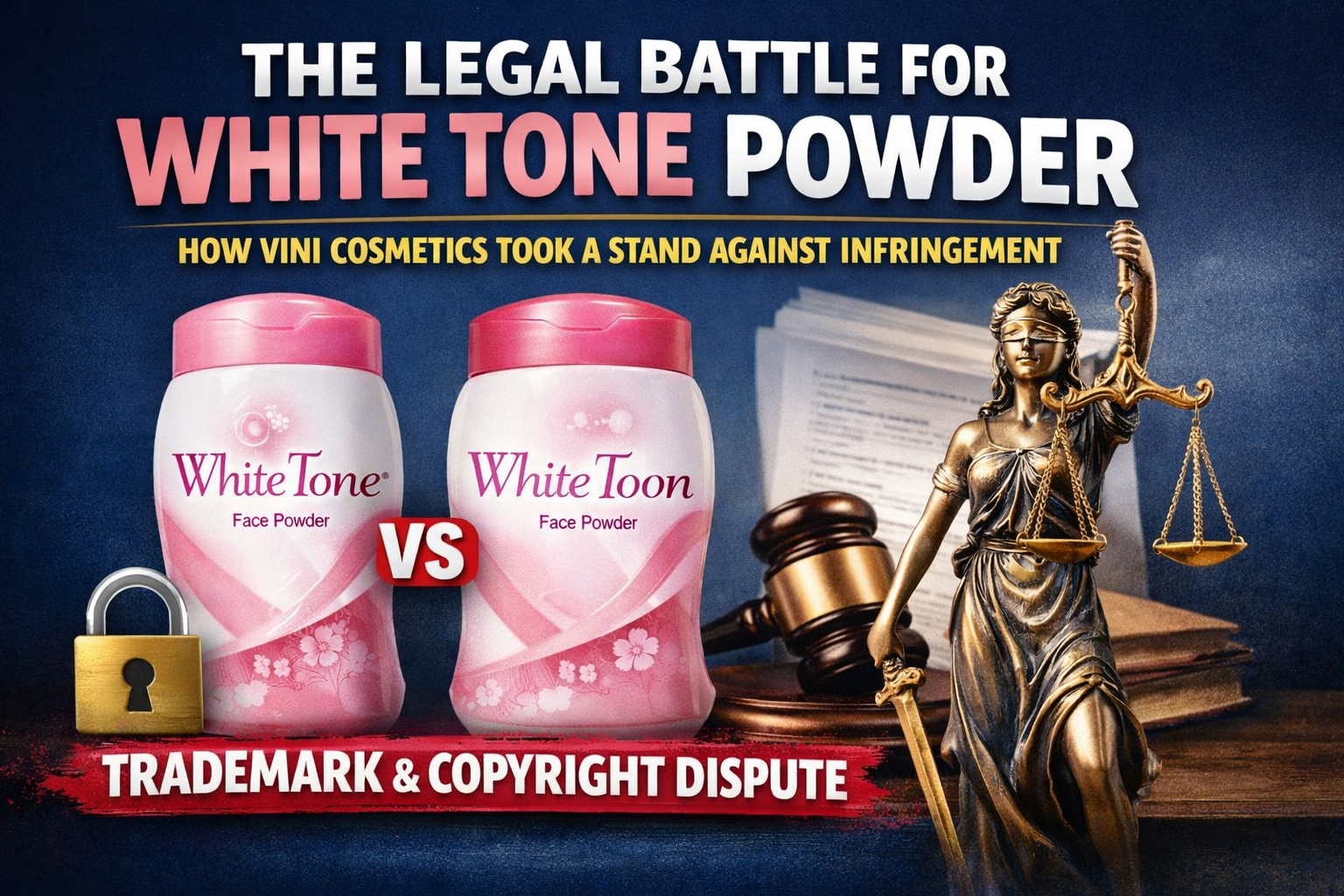
The case of M/S Vini Cosmetics Pvt. Ltd. vs. Manjeet Kumar highlights the growing importance of brand protection and intellectual property rights in India. It focuses on issues of trademark and copyright infringement concerning the popular cosmetic brand “White Tone.” Vini Cosmetics, a reputed company in the personal care industry, accused Manjeet Kumar of using deceptively similar branding and packaging to sell counterfeit goods.
The Delhi Commercial Court, after finding clear and uncontested evidence, granted a permanent injunction in favour of Vini Cosmetics. This case demonstrates how timely legal action can protect brand reputation and prevent consumer deception in the marketplace.
BACKGROUND OF THE CASE:
M/S Vini Cosmetics Pvt. Ltd., incorporated in 2009 and based in Ahmedabad, is one of India’s leading manufacturers and exporters of personal care products such as talcum powder, face powder, creams, shampoos, and soaps. The company markets its products under the trademark WHITE TONE, along with variants such as WHITETONE PICTURE PERFECT, used since 2010. It is also known for other popular brands like Fogg deodorants and owns several registered trademarks.
The defendant, Manjit Kumar, applied for a mark similar to Vini’s existing trademark and adopted packaging closely resembling that of White Tone. A raid conducted by a local commissioner revealed counterfeit goods being sold under the impugned mark. The court found this imitation to be deliberate and intended to deceive consumers. Since the defendant Manjit kumar failed to appear or contest the claim, the court granted a permanent injunction restraining him from using any identical or deceptively similar mark or packaging.
This judgment reinforced that businesses must actively protect their intellectual property to prevent erosion of consumer trust and goodwill.
LEGAL GROUNDS:
The case was based on three primary legal claims — trademark infringement, passing off, and copyright infringement.
Vini Cosmetics argued that the defendant’s unauthorized use of a similar mark and packaging amounted to infringement under the Trade Marks Act, 1999. Such imitation caused consumer confusion and exploited the plaintiff’s goodwill. The defendant’s conduct also amounted to passing off, since he attempted to pass off his goods as those of the plaintiff M/S Vini Cosmetics Pvt. Ltd.
Additionally, the plaintiff’s packaging and artwork were protected as artistic works under the Copyright Act, 1957. The replication of colour schemes, fonts, and layouts violated these rights. As the defendant Manjit kumar did not file a written statement, the court proceeded ex parte and relied on the commissioner’s report, invoking Order 8 Rule 10 of the CPC, to rule in favour of Vini Cosmetics.
TRADEMARK INFRINGEMENT
The key issue before the Court was whether the defendant’s use of a mark and packaging similar to WHITE TONE constituted infringement. Under Sections 29(1) and 29(2) of the Trade Marks Act, 1999, unauthorized use of an identical or deceptively similar mark for identical goods is infringement.
The Court observed that the defendant’s mark, colour palette, and overall trade dress were nearly identical to those of the plaintiff M/S Vini Cosmetics Pvt. Ltd, leading to an inevitable likelihood of confusion among consumers. This imitation diluted the goodwill of Vini’s brand and interfered with its statutory rights. Accordingly, the Court held this to be a clear case of trademark infringement.
COPYRIGHT INFRINGEMENT
Beyond the trademark issue, the defendant Manjit kumar had also copied the artistic packaging of the plaintiff’s products. Under Section 13 of the Copyright Act, 1957, artistic works such as packaging, layout, and colour schemes are protected.
The Court held that Vini Cosmetics, being the first owner of the packaging design, enjoyed exclusive rights under Section 17. The defendant’s reproduction of these features without authorization infringed upon those rights under Section 14. The commissioner’s raid revealed counterfeit goods with identical packaging, establishing a violation under Section 51. The Court therefore held that the plaintiff M/S Vini Cosmetics Pvt. Ltd was entitled to remedies under Section 55, including injunction and damages.
THE “JOHN DOE” PRINCIPLE AND THE CASE’S EVOLUTION:
The “John Doe” Principle
An interesting feature of this case was how it originated. Vini Cosmetics initially filed the suit as a “John Doe” or “Ashok Kumar” suit — a legal strategy used to act against unknown infringers. At the time of filing, the company was unaware of the identity of the person behind the counterfeit products.
Later, through investigation, the infringer was identified as Manjit Kumar, trading as Shree Ram Cosmetics. This demonstrates how John Doe orders are effective in preventing the spread of counterfeit products when the infringer’s identity is initially unknown.
Courts generally grant such orders when:
- A valid IP right exists.
- There is evidence of large-scale infringement.
- The infringers cannot be identified immediately.
- There is urgency to prevent irreparable harm.
- The plaintiff establishes a prima facie case and balance of convenience.
LEGAL ISSUES:
The Court considered three key questions:
- Whether the impugned mark and trade dress adopted by the defendant Manjit kumar were deceptively similar to the plaintiff’s registered mark.
- Whether such use amounted to infringement under Sections 29(1) and 29(2) of the Trade Marks Act.
- Whether the defendant’s adoption of the mark showed dishonest intent and bad faith.
ARGUMENTS:
The plaintiff M/S Vini Cosmetics Pvt. Ltd argued that the defendant Manjit kumar had deliberately copied the colour combination, layout, and trade dress of the White Tone product to mislead the public and ride on the plaintiff’s reputation. The imitation, it claimed, was deliberate and aimed at exploiting consumer trust.
The defendant Manjit kumar, however, claimed that his mark was distinct and adopted in good faith. Since he failed to produce evidence or contest the case, the Court accepted the plaintiff’s arguments as unchallenged.
COURT’S OBSERVATIONS AND RULING:
The Delhi District Court, referring to Cadila Health Care Ltd. v. Cadila Pharmaceuticals Ltd. (2001) 5 SCC 73, reiterated that trademarks must be compared as a whole and not dissected into individual elements. On comparison, the Court found the marks and packaging strikingly similar in phonetics, structure, and visual appearance.
Considering that both parties operated in the same product segment, the Court held that consumer confusion was not only probable but inevitable. It also noted that Vini Cosmetics had acquired significant goodwill through continuous use, while the defendant’s conduct reflected dishonest adoption intended to benefit from that goodwill.
Accordingly, the Court decreed the suit in favour of Vini Cosmetics and granted a permanent injunction restraining the defendant Manjit kumar from manufacturing, selling, or advertising goods bearing the infringing mark or packaging.
IMPLICATIONS OF THE JUDGMENT:
The ruling reinforces that established trademarks are entitled to strong protection against deceptive similarity. It emphasizes that counterfeiters and small traders cannot use identical branding to take unfair advantage of reputed marks. The decision also upholds consumer protection and brand integrity, ensuring that consumers receive authentic goods and not imitations.
This case further demonstrates the judiciary’s consistent commitment to upholding intellectual property rights in India and ensuring swift remedies for brand owners.
CURRENT STATUS:
As per available records, the Commissioner’s report remains unchallenged, and no appeal has been filed against the decision. The permanent injunction continues to remain operative.
Through this case, Vini Cosmetics successfully preserved its brand identity and reinforced the message that vigilant IP enforcement is essential in today’s competitive market.

Leave a Reply