
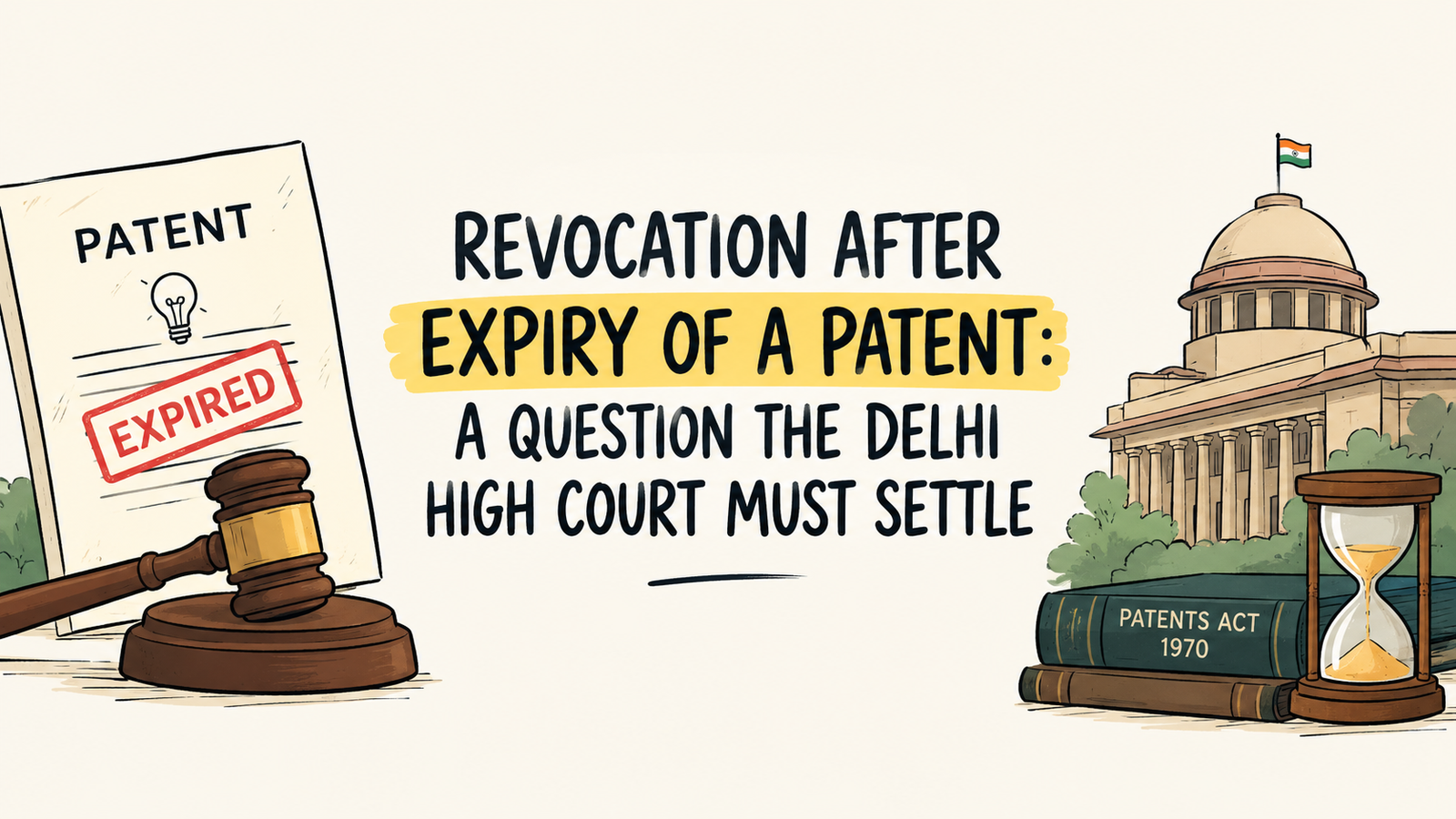
INTRODUCTION
Patent law rests on a carefully calibrated compromise: exclusive rights are granted for a limited time in exchange for public disclosure. Once that term expires, the invention enters the public domain. Yet, the expiration of patent rights does not always mark the end of their legal relevance. Claims for damages, accounts of profits, and other liabilities arising from alleged past infringement frequently survive expiry. This raises a foundational question: can a patent whose term has expired still be revoked?
This issue has recently come to the fore in proceedings before the Delhi High Court involving the Linagliptin species patent. Conflicting approaches adopted by the Single Judge Bench (“SB”) and the Division Bench (“DB”) have exposed deeper doctrinal tensions regarding the nature of revocation, the temporal scope of patent validity, and the purpose of Section 64 of the Patents Act, 1970. This article argues that revocation is not a forward-looking remedy tied to the life of the patent, but a backward-looking declaration of invalidity that operates ex tunc. Consequently, where an expired patent continues to generate legal consequences particularly through infringement litigation the right to seek revocation must remain available.
FACTUAL BACKGROUND: THE GENUS SPECIES PATENT DISPUTE
The litigation arose from a genus species patent arrangement covering Linagliptin, an anti-diabetic drug. The genus patent expired on 21 February 2022, following which Macleods Pharmaceuticals launched its generic product on 22 February 2022. Anticipating enforcement action under the subsisting species patent (expiring on 18 August 2023), Macleods filed a revocation petition before the Delhi High Court. Subsequently, the patentee initiated an infringement suit before the Himachal Pradesh High Court, securing an interim injunction. After the species patent expired, the patentee moved an application before the Delhi High Court seeking dismissal of the revocation petition on the ground that it had become infructuous due to expiry.
THE SINGLE JUDGE’S APPROACH: RESIDUAL ENFORCEMENT AS THE DECISIVE FACTOR
The Single Judge rejected the contention that patent expiry automatically extinguishes the right to seek revocation. The Court focused on the continuing assertion of rights arising from the expired patent, particularly claims for damages for alleged past infringement. The SB held that where a patentee relies on an expired patent to impose legal liability for past conduct, the validity of that patent remains a live and justiciable issue. Denying the alleged infringer, the opportunity to challenge validity in such circumstances would result in procedural and substantive unfairness.
Crucially, the SB did not hold that expired patents can always be revoked. Instead, it tied the maintainability of revocation to the specific factual matrix, namely:
- Pendency of infringement proceedings
- Assertion of past infringement claims
- Continuing legal consequences flowing from the patent
Thus, revocation was treated as defensive and corrective, not merely prospective.
THE DIVISION BENCH’S PRIMA FACIE VIEW: FORMALISM AND PATENT TERM
On appeal, the Division Bench expressed prima facie disagreement. Observing that revocation conceptually presupposes the existence of a “live” patent, the DB posed the rhetorical question:
“Can one kill a dead body?” Although the DB acknowledged that Section 64 does not explicitly prohibit revocation of expired patents, it nonetheless suggested that revocation inherently applies only during the patent’s statutory term. This approach effectively introduces a temporal limitation not found in the statutory text. The DB also questioned the persuasive value of earlier authorities suggesting that expired patents may be revoked, while clarifying that its views were preliminary.
THE LIMITS OF THE “DEAD BODY” ANALOGY
The Division Bench’s analogy, while rhetorically compelling, fails to capture the legal reality of expired patents. An expired patent is not legally inert if it continues to:
- Ground infringement suits;
- Support claims for damages or accounts of profits; or
- Shape commercial and legal liabilities for past conduct.
Patent expiry extinguishes prospective exclusivity, not retrospective enforcement. Treating expired patents as incapable of revocation ignores their continuing juridical effects and conflates expiry with invalidity.
SECTION 64 AS A CORRECTIVE MECHANISM
Section 64 permits revocation of “any patent” granted before or after the commencement of the Act. The provision contains no express temporal limitation and must be read in light of the broader patent framework, which includes:
- Pre-grant opposition,
- Post-grant opposition,
- Revocation proceedings, and
- Invalidity defenses in infringement suits.
These mechanisms reflect legislative recognition that patent examination is fallible. In an institutional context marked by increasing filings, performance metrics favoring grants, and repeated judicial remands for unreasoned Controller decisions, Section 64 functions as a systemic safeguard. Understanding revocation as a corrective remedy aligns with its purpose: preventing the enforcement of legally invalid monopolies against the public.
COMPARATIVE JURISPRUDENCE: NORTH EASTERN MARINE ENGINEERING
The UK Court of Appeal’s decision in North Eastern Marine Engineering Co. Ltd v Leeds Forge Co. Ltd supports this purposive view. The Court held that the mere fact of patent expiry is not sufficient to reject a revocation petition, particularly where infringement liability for past acts is apprehended.
Notably, the trigger in that case was only a threat of enforcement. In the Linagliptin litigation, infringement proceedings were actively pending, making the case for revocation even stronger.
REVOCATION AND EX TUNC INVALIDITY
Revocation operates by declaring that a patent lacked legal validity from the moment of its grant. This retrospective character of revocation is fundamentally incompatible with any rule that restricts revocation to the subsistence of the patent term. If revocation were barred solely because a patent has expired, courts would be left with no option but to recognize and enforce rights that, in law, never validly came into existence.
Such an approach would not only distort the doctrinal distinction between expiry and invalidity but would also undermine core rule-of-law principles and the public interest, by allowing legally defective patents to continue producing enforceable legal consequences merely by the passage of time.
CONCLUSION
The disagreement between the SB and DB is not irreconcilable. The SB adopts a purposive, consequence-based approach, while the DB’s prima facie view reflects a formalistic, term-based conception of revocation. Ultimately, the purpose of Section 64 is not to “kill” patents, dead or alive, but to prevent the enforcement of legally invalid monopolies. Where expired patents continue to generate legal consequences, revocation must remain available. Focusing solely on patent term distracts from the real issue: whether an invalid patent is being used to impose legal burdens on the public. If the answer is yes, revocation cannot be denied merely because time has passed. The DB’s clarification that its views are preliminary leaves the door open for a jurisprudential course correction one that aligns doctrine with both statutory text and systemic purpose.

Leave a Reply