
INTRODUCTION
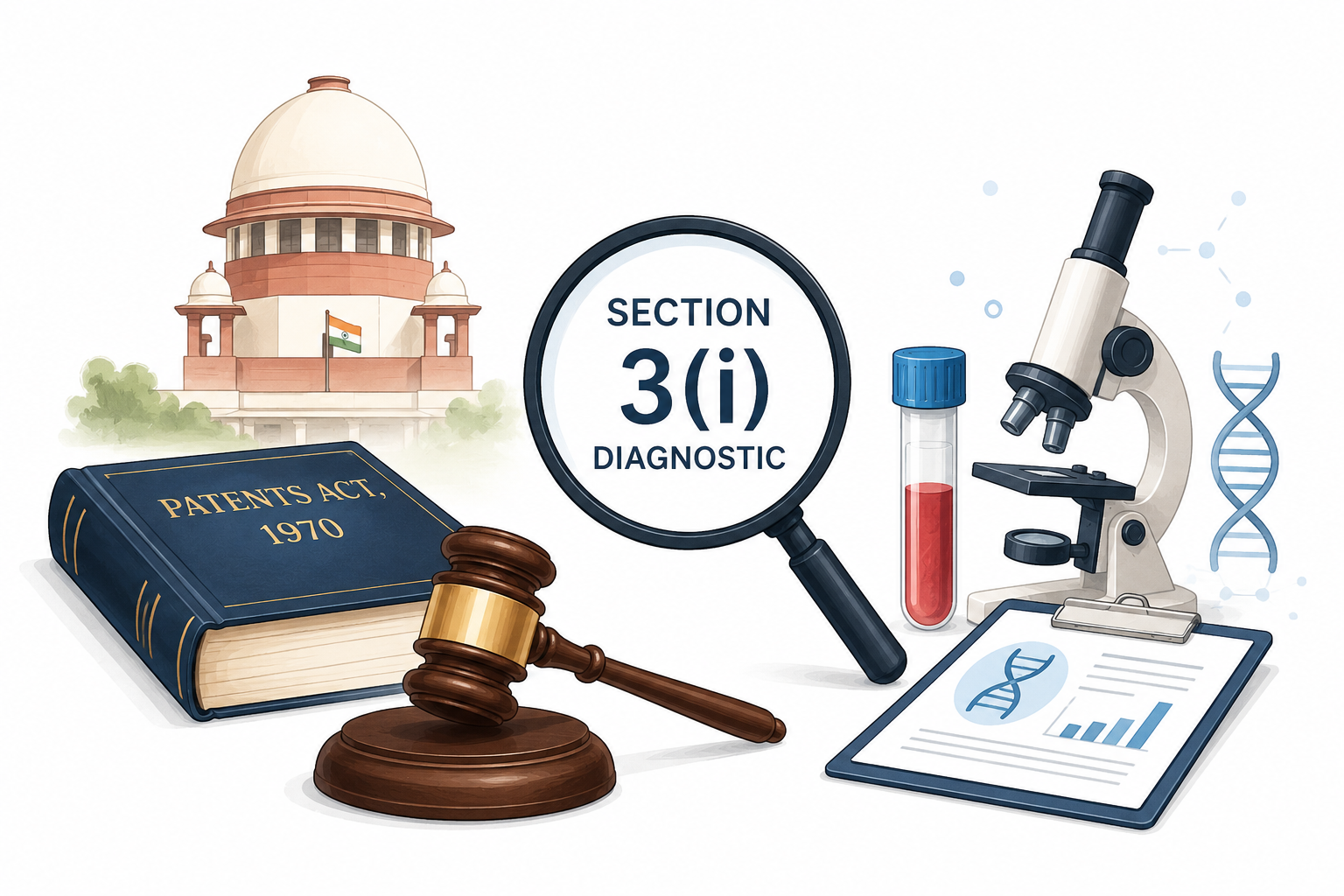
The patentability of diagnostic methods has long been a contentious issue in Indian patent law. Section 3(i) of the Patents Act, 1970 expressly excludes “any process for the medicinal, surgical, curative, prophylactic, diagnostic, therapeutic or other treatment of human beings or animals” from patent protection. While the legislative intent behind this exclusion is rooted in public health and access to medical care, its interpretation particularly with respect to diagnostic processes has been the subject of sustained judicial and administrative scrutiny. In recent years, the Delhi High Court has played a pivotal role in clarifying the scope and contours of Section 3(i), especially in cases involving modern diagnostic technologies, in vitro testing, and laboratory-based processes. The Delhi High Court’s evolving assessment of diagnostic processes under Section 3(i), analyzing its legal reasoning, interpretative framework, and broader implications for innovation in medical diagnostics.
UNDERSTANDING SECTION 3(I)
Section 3 of the Patents Act enumerates what are not inventions within the meaning of the Act. Clause (i) specifically excludes: “any process for the medicinal, surgical, curative, prophylactic, diagnostic, therapeutic or other treatment of human beings or animals to render them free of disease or to increase their economic value or that of their products.” The exclusion is absolute in nature and reflects India’s policy choice to prioritize public health over monopolistic rights in medical treatment. However, the statute does not define the term “diagnostic,” leaving considerable room for interpretation. Traditionally, the Indian Patent Office (IPO) has adopted a conservative stance, often rejecting claims relating to diagnostic methods even when such methods are conducted entirely outside the human or animal body. The Delhi High Court’s jurisprudence has increasingly sought to bring clarity and balance to this approach.
JUDICIAL INTERPRETATION: MOVING BEYOND A LITERAL APPROACH
One of the most significant contributions of the Delhi High Court has been its rejection of an overly literal or mechanical application of Section 3(i). The Court has emphasized that not every invention connected with diagnosis is automatically excluded; rather, the determining factor lies in the nature, purpose, and effect of the claimed process. The Court has repeatedly underscored that a diagnostic process, to fall within the mischief of Section 3(i), must be integrally linked to the identification of a disease or pathological condition for treatment. Mere data collection, detection of biomarkers, or analytical processes that do not themselves result in a diagnostic conclusion may fall outside the exclusion. This nuanced interpretation marks a departure from the earlier practice of treating all diagnostic-related claims as inherently non-patentable.
DISTINCTION BETWEEN “DIAGNOSTIC METHODS” AND “TECHNICAL PROCESSES”
A recurring theme in Delhi High Court decisions is the distinction between:
- Diagnostic methods practiced on the human or animal body, and
- Technical or laboratory processes that merely generate diagnostic information.
The Court has recognized that modern diagnostics often involve sophisticated in vitro techniques, algorithms, or devices that operate independently of the human body. Where the claimed invention is limited to a technical process, such as analyzing a biological sample, processing data, or detecting a molecular marker, the Court has shown willingness to treat such claims as potentially patentable provided they do not culminate in a medical diagnosis per se.
This distinction aligns Indian jurisprudence more closely with international patent practices, while still remaining faithful to the statutory exclusion.
THE “OUTCOME-ORIENTED” TEST
Another important contribution of the Delhi High Court is its outcome-oriented analysis. Rather than focusing solely on the wording of the claims, the Court examines the end result of the claimed process.
If the outcome of the process is a definitive diagnosis that informs treatment decisions, the process is likely to be excluded under Section 3(i). Conversely, if the outcome is merely intermediate information, such as identifying a biological parameter or generating a risk score that requires further medical interpretation, the exclusion may not apply. This approach ensures that Section 3(i) is not used as a blunt instrument to stifle innovation in emerging diagnostic technologies.
ROLE OF CLAIM DRAFTING AND SPECIFICATION
The Delhi High Court has also highlighted the critical importance of claim drafting in determining patentability under Section 3(i). Poorly drafted claims that explicitly refer to “diagnosing a disease” or “identifying a medical condition” are more vulnerable to exclusion.
In contrast, claims framed around technical steps, apparatus, or data processing mechanisms, without directly claiming the act of diagnosis, stand a better chance of surviving scrutiny. The Court’s observations implicitly place greater responsibility on patent applicants to clearly delineate the technical contribution of their inventions.
This judicial guidance serves as an important roadmap for innovators and patent practitioners operating in the life sciences domain.
PUBLIC HEALTH CONSIDERATIONS AND POLICY BALANCE
While adopting a more refined interpretative approach, the Delhi High Court has remained mindful of the underlying public health rationale of Section 3(i). The Court has reiterated that patent protection must not impede access to medical treatment or create monopolies over essential diagnostic practices performed by medical professionals.
At the same time, it has acknowledged that blanket exclusions may discourage investment in diagnostic research, particularly in areas such as molecular diagnostics, personalized medicine, and AI-driven health technologies. The Court’s jurisprudence reflects an attempt to strike a delicate balance between safeguarding public interest and encouraging technological advancement.
IMPLICATIONS FOR THE INDIAN INNOVATION ECOSYSTEM
The Delhi High Court’s evolving stance has significant implications for India’s healthcare and innovation ecosystem. By narrowing the scope of exclusion under Section 3(i) through principled interpretation, the Court has opened the door for greater patent protection in diagnostics particularly for inventions that are technical, device-oriented, or laboratory-based. This shift is likely to enhance investor confidence, promote domestic R&D, and align India’s patent regime with global innovation trends, while still respecting statutory boundaries.
CONCLUSION
The Delhi High Court’s interpretation of diagnostic processes under Section 3(i) marks a significant development in Indian patent jurisprudence. In 2023, Justice Prathiba M. Singh played a pivotal role in refining the scope of the diagnostic exclusion, particularly through her reasoned and technology-sensitive approach. The Court moved beyond a rigid and literal application of the provision, instead adopting a contextual and outcome-oriented framework that accounts for the realities of modern diagnostic science. By clearly distinguishing between therapeutic or diagnostic treatment on the human body and technical or laboratory-based processes, and by prioritizing the substance of claims over their formal wording, the Court has injected much-needed clarity into an otherwise uncertain area of law. This balanced interpretation safeguards public health objectives while simultaneously encouraging innovation in the rapidly evolving field of medical diagnostics, thereby shaping the future trajectory of patent protection in India.


Leave a Reply