
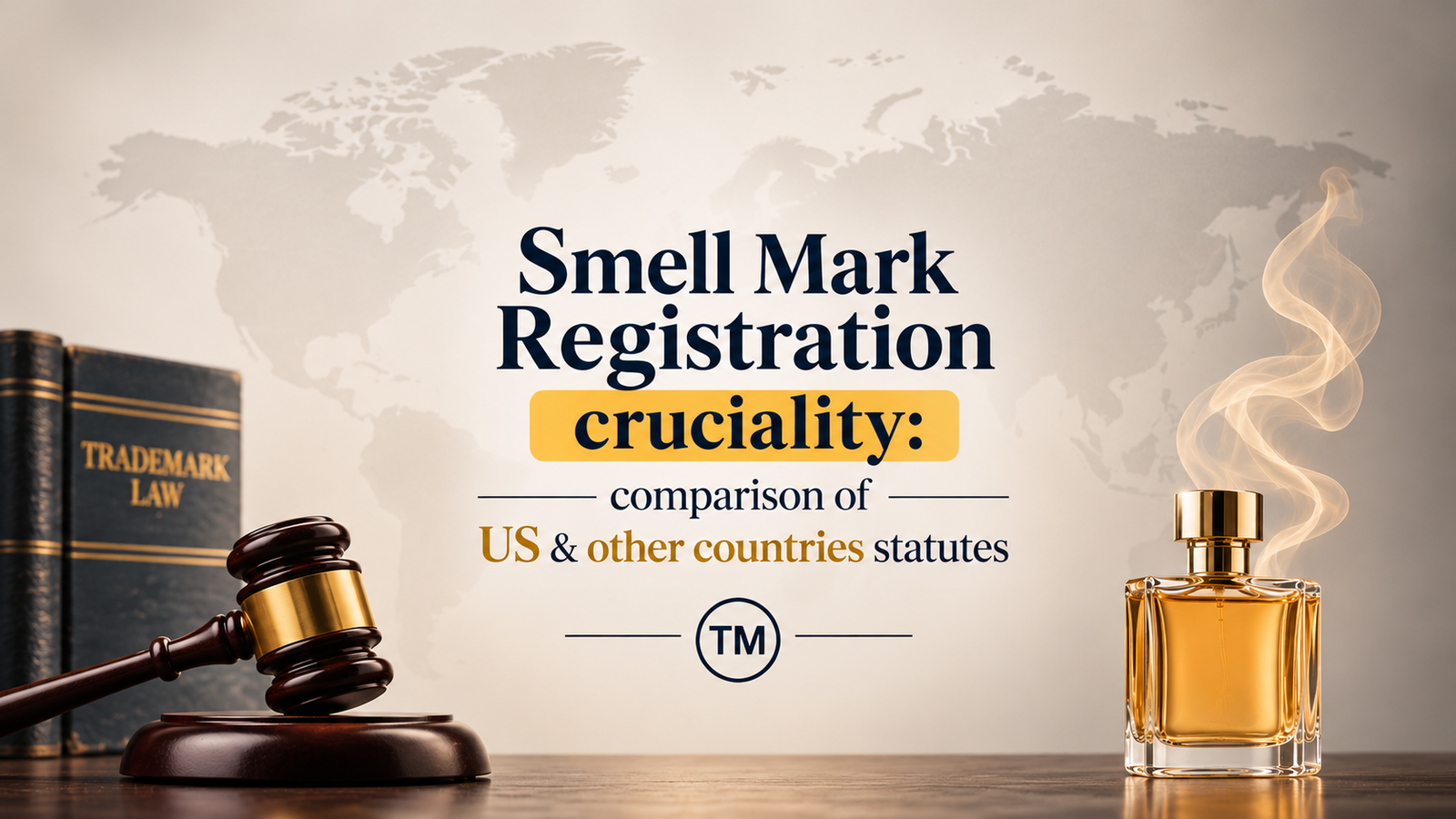
Why the U.S. Stance on Olfactory Trademarks Can Mislead Brand Owners Worldwide
In the evolving world of trademarks, one question repeatedly surfaces: Can a smell be protected as a trademark?
The answer is yes—but it depends heavily on the country you’re looking at. And if you’re relying on the United States as your benchmark, you might be setting yourself up for confusion.
The U.S. takes a distinctly narrow, almost reluctant approach to smell marks. Other jurisdictions—particularly the EU, India, and several common law countries—are already shaping more nuanced frameworks. Understanding these differences is crucial for modern brand owners, especially in industries like cosmetics, hospitality, retail, healthcare, and luxury goods, where sensory branding is growing rapidly.
- The Strange Case of Smell Marks in the United States
The United States is often seen as an innovation-friendly jurisdiction. It was also one of the first countries to recognise a smell trademark. In 1990, the USPTO granted registration for a “high-impact, fresh, floral fragrance reminiscent of Plumeria blossoms” used on sewing thread. Since then, the number of registered smell marks in the U.S. has been… shockingly low.
2. Why? Because the U.S. uses a very strict test
The United States takes a very narrow view of olfactory trademarks, starting with its strict functionality rule: a scent is only registrable if it serves no practical purpose. Any fragrance that masks odours, enhances the product’s natural smell, or adds utility is automatically rejected, effectively excluding perfumes, soaps, detergents, candles, and most aromatic goods. Even for non-functional scents, applicants must prove strong acquired distinctiveness—showing that consumers directly associate the smell with the brand. Because scents cannot be easily advertised or displayed, collecting such evidence is extremely difficult, making U.S. smell mark registrations rare.
Underlying these hurdles is the U.S. trademark system’s general skepticism toward smell marks, treating them as theoretical possibilities rather than practical realities. As a result, relying on U.S. precedent often misleads brand owners into assuming that scent marks are unrealistic or legally unstable—even though many other jurisdictions take a more progressive and accommodating view.
3. The First U.S. Scent Trademark: In re Clarke
The only well-known success story in U.S. olfactory trademarks is In re Clarke (1990), where the USPTO allowed registration for “a high-impact, fresh, floral fragrance reminiscent of Plumeria blossoms” used on sewing thread. The key reason this scent was registrable was that it served no functional purpose—the fragrance did not enhance the thread, mask any odour, or add utility. The applicant also provided compelling evidence that consumers had come to associate the scent specifically with their sewing thread.
This case is often cited as the exception that proves the rule: unless a scent is completely non-functional and distinctiveness is strongly proven, the U.S. will almost always refuse registration.
4. India: A Jurisdiction Still Evolving
India does not yet expressly recognise smell trademarks, but the law remains flexible: under Section 2(1)(zb) of the Trade Marks Act, any sign capable of graphic representation and distinguishing goods or services may qualify. The main challenges have been graphic representation and traditional examination standards.
However, India is modernising quickly, influenced by EU reforms and the rise of sensory branding, and is likely to adopt scientific and technology-based methods for representing scents. Unlike the U.S., India has no absolute bar on scented products, giving it greater theoretical openness—even though actual registrations remain limited.
- Why the U.S. Approach Misleads Global Brand Owners
Businesses often assume that if the United States does not permit smell trademarks, other countries won’t either, or that U.S. standards reflect global norms—but both assumptions are wrong. The U.S. still treats olfactory marks as legal oddities, while many other jurisdictions recognise them as part of modern sensory branding. Today, brands rely heavily on signature store scents, product-identifying aromas in toys and books, ambient aromas in hospitality, and distinctive formulation smells in foods and skincare.
As this trend grows, global trademark systems are adapting. But the U.S. remains tied to outdated ideas of representation and distinctiveness, even as technology now allows chemical formula mapping, scent sampling, and emerging digital scent tools. By not keeping pace, the U.S. risks falling behind jurisdictions that are increasingly open to protecting olfactory branding.
What Brand Owners Should Do (Practical Guidance)
When seeking scent-based trademark protection, businesses should be cautious about using the United States as a benchmark, as the USPTO remains highly restrictive in practice. Although EU and UK law formally permits scent marks, successful registrations are rare due to ongoing representation and distinctiveness hurdles, while Australia offers a more workable framework. However, a recent development in India—where a rose-scent mark was filed for registration—reflects growing openness toward scent marks. Applicants should carefully document the scent and build distinctiveness through consistent use, and, as global approaches continue to develop, consider strategic filings in receptive jurisdictions to strengthen international protection.
Conclusion: The Future of Smell Marks Is Global—Not American
In conclusion, while the United States remains highly restrictive toward olfactory trademarks, it is no longer the model for global practice. Many other jurisdictions are increasingly open to recognising scent marks, supported by modern technology and more flexible legal standards. Brand owners should therefore look beyond the U.S. and align their strategies with more progressive systems, ensuring that distinctive scents when properly documented and represented can serve as powerful and protectable brand identifiers.


Leave a Reply