
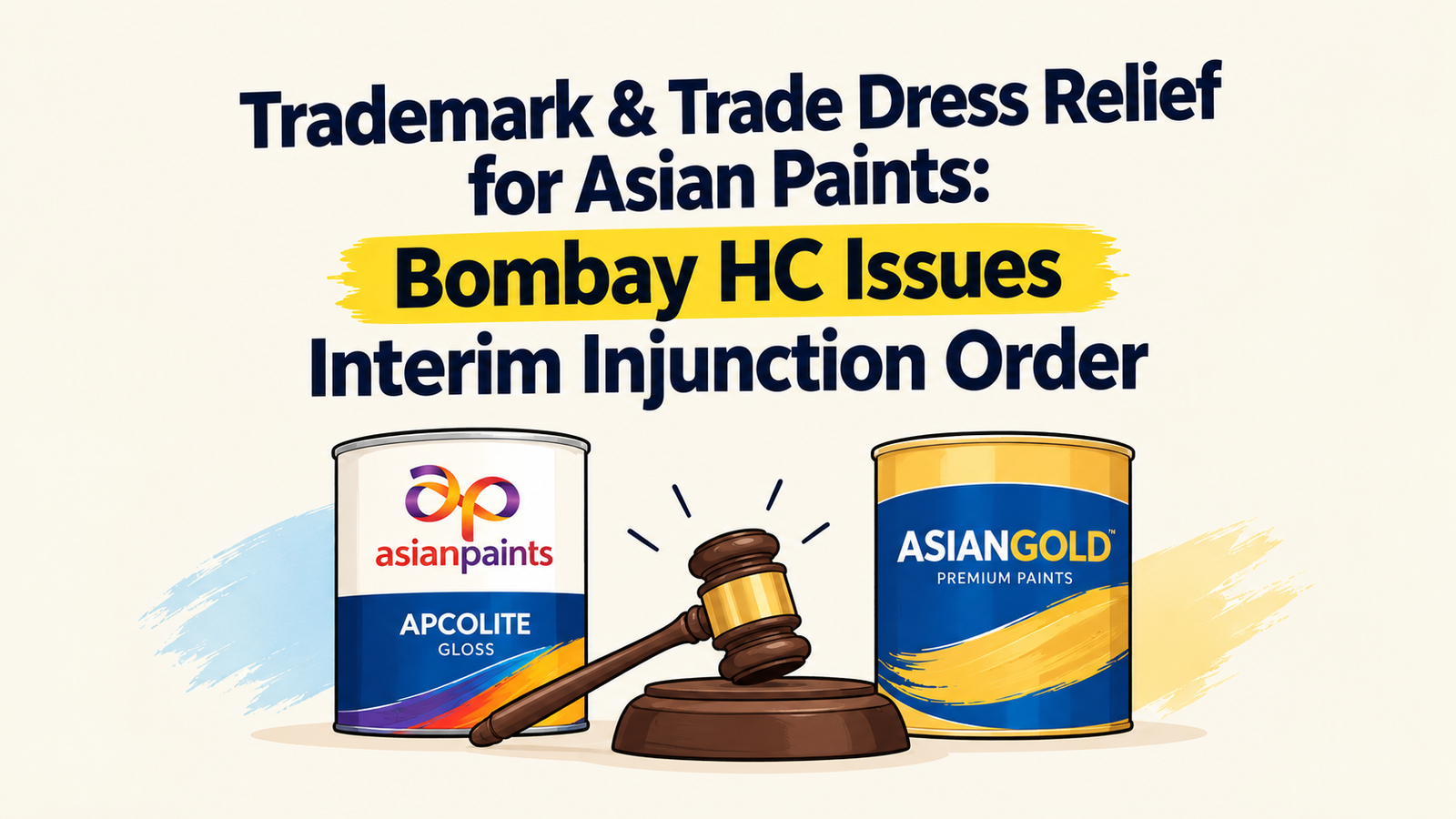
Trademark & Trade dress Relief for Asian Paints: Bombay HC Issues Interim Injunction Order
Background of the Dispute
Asian Paints approached the Bombay High Court alleging that a rival manufacturer was infringing its trademarks by using the marks “ASIANGOLD” and “SUPREME GLOSS.” The company argued that these marks were confusingly similar to its well-known brands, amounting to trademark infringement and passing off. It claimed that such use could mislead consumers into believing the rival’s products were associated with Asian Paints, thereby risking dilution of its long-established goodwill and reputation.
This matter arose before the Bombay High Court in the case of Asian Paints Ltd. vs. Vinod Satyaprakashji Mittal & Ors., wherein an interim order dated 18 November 2025 was passed by Justice Sharmila U. Deshmukh.
Asian paints Ltd.’s Submissions
Asian Paints argued that it is a highly reputed paint manufacturer with well-known trademarks such as “ASIAN” and “ASIAN PAINTS.” Vinod Satyaprakashji Mittal’s (Defendant) use of the mark “ASIANGOLD” was alleged to be a dishonest attempt to exploit this reputation, as it incorporates the key and distinctive element “ASIAN,” creating a clear likelihood of consumer confusion.
Asian Paints Ltd (Plaintiff) also contended that Vinod Satyaprakashji Mittal’s packaging and trade dress for “SUPREME GLOSS” closely imitated Asian Paints’ “APCOLITE GLOSS,” and that Vinod Satyaprakashji Mittal’s wall-putty designs were deceptively similar to the Asian Paints Ltd.’s “TRUCARE” trade dress. These similarities, they argued, were deliberate and intended to mislead consumers into believing the products were associated with Asian Paints.
Asian Paints (Plaintiff) also accused the Vinod Satyaprakashji Mittal & Ors (Defendant) of copying its original artistic works, amounting to copyright infringement. Vinod Satya prakashji Mittal’s repeated absence in court was cited as evidence of bad faith. With a strong prima facie case of infringement, passing off, and copyright violation, the company urged the Court to confirm the injunction.
| Plaintiff
(Asian Paints Ltd.) |
Defendant
(Vinod Satyaprakashji Mittal & Ors.) |
|
| Trademark similarity | Asian / Asian paints | Asian gold |
| Trade dress/
packaging similarity |
Apcolite gloss | Supreme gloss |
| Trade dress/
packaging similarity |
Trucare | wall putty designs |
Defendant’s Non-Appearance and Implied Admission (Vinod Satyaprakashji Mittal & Ors.)
Defendant, Vinod Satyaprakashji Mittal, neither appeared nor filed a reply despite being duly served. With no explanation for adopting the marks “ASIANGOLD” or “SUPREME GLOSS,” and no rebuttal to Asian Paints’ claims of infringement and passing off, the Court noted that his continued absence—despite earlier prima facie findings—suggested a lack of legitimacy. This non-participation effectively amounted to an implied admission, further strengthening the Asian Paints Ltd.’s case for confirming the injunction.
Why the Court Found the Marks Deceptively Similar
The Court found the marks deceptively similar because Vinod Satyaprakashji Mittal’s (Defendant) mark “ASIANGOLD” incorporated the dominant and distinctive element “ASIAN,” which is strongly associated with Asian Paints (Plaintiff). It further observed that “ASIANGOLD” is visually and phonetically close to “ASIAN PAINTS,” thereby increasing the likelihood of consumer confusion.
Since both parties deal in identical goods such as paints and putty, the probability of mistaken association was significantly higher. The resemblance in packaging and colour schemes reinforced the impression of deliberate imitation. Moreover, Vinod Satyaprakashji Mittal’s (Defendant) failure to provide any plausible justification for adopting a similar mark was viewed as indicative of bad faith.
Legal Basis for the Interim Relief
The interim relief in this case was grounded on well-settled principles of trademark law in India, particularly:
To secure an interim injunction in a trademark dispute, the applicant must show a prima facie case and a plausible likelihood of infringement. Courts assess whether the rival mark may confuse consumers by examining factors such as visual and phonetic similarity, overall commercial impression, and the nature of the goods. In this case, the Bombay High Court found that Vinod Satyaprakashji Mittal ‘s (Defendant) marks “ASIANGOLD” and “SUPREME GLOSS” were sufficiently similar to Asian Paints’ marks to potentially mislead consumers.
Another key requirement for interim relief is proving irreparable harm — injury that cannot be compensated by money. The Court held that dilution of a well-known brand and loss of consumer trust amount to such harm, justifying early protective measures.
The Court’s Order
In its ruling, the Bombay High Court reaffirmed an earlier ad-interim injunction granted on 18 November 2025, and extended this relief in favour of Asian Paints (Plaintiff). The court directed that the rival manufacturer be temporarily restrained from manufacturing, advertising, selling, distributing, or otherwise using the impugned marks “ASIANGOLD” and “SUPREME GLOSS” in relation to paints, putty, or related products.
Although the order is interim — pending the full trial of the suit — it underscores the likelihood that the court is inclined to see merit in Asian Paints’ claim of infringement and deceptive similarity.
Such interim orders are especially significant in trademark disputes because they aim to preserve the status quo and protect brand identity while the substantive legal issues are adjudicated.
Implications for Trademark Enforcement in India
The Trade Marks Act, 1999 protects both registered and well-known marks from infringement and dilution, and the Bombay High Court’s grant of interim relief in this case reinforces the judiciary’s commitment to safeguarding brand owners early while deterring confusingly similar branding.
At the heart of trademark disputes is consumer confusion, with courts considering not just formal rights but the real-world impact on perception and the marketplace. Interim injunctions serve as a strategic tool for rights holders to halt ongoing misuse and prevent further harm, while signalling the risks of adopting infringing marks. This decision also reflects a broader 2025 trend of the Bombay High Court actively protecting trademark and copyright rights across industries, from paints to personal care and food products.
Why Brand Owners Should Monitor Such Judgments
Decisions like this highlight key lessons for trademark owners: interim orders offer precedential insights into balancing rights and competition; understanding courts’ views on deceptive similarity helps mitigate branding risks; and early relief can shape overall litigation strategy. In a crowded marketplace, proactive legal guidance and enforcement are essential to protect brand distinctiveness and maintain a competitive edge.
Conclusion
The Bombay High Court’s interim relief in favour of Asian Paints (Plaintiff) serves as a compelling reminder of the robust protection available to trademark owners in India. By restraining a competitor from using marks the court found likely to cause confusion, the judgment reinforces fundamental principles of trademark law — particularly the need to preserve goodwill and prevent consumer deception.
As this case progresses, businesses and legal practitioners alike will continue to monitor its developments, using insights from the interim order to shape both enforcement and defence strategies in India’s dynamic IP landscape.



Leave a Reply