
INTRODUCTION
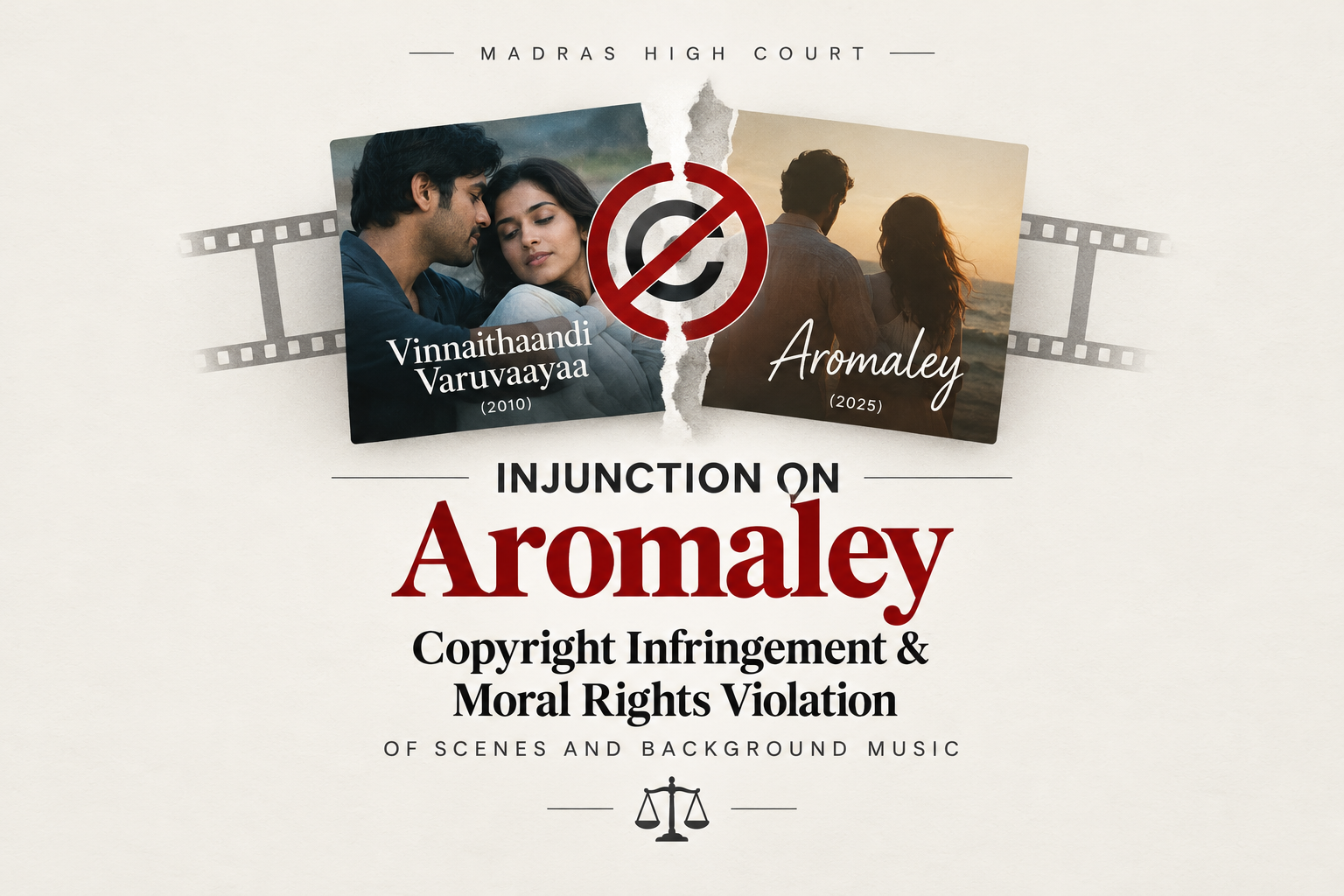
In November 2025, a legal storm hit the Tamil film industry when the Madras High Court issued an interim injunction against the producers of the newly released film “Aromaley ”. The court restrained them from using scenes and background music from the 2010 cult romantic drama “Vinnaithaandi Varuvaayaa” (VTV), citing copyright infringement. This decision underscores the growing tension in the film world between creative homage and unauthorized reuse, and serves as a strong signal about respecting intellectual property rights in cinema.
BACKGROUND
- The Original Film “Vinnaithaandi Varuvaayaa” Released in 2010, Vinnaithaandi Varuvaayaa is a romantic Tamil film produced by RS Infotainment and Escape Artists Motion Pictures. As the rights‑holding producer, RS Infotainment claims comprehensive ownership over the film’s creative elements including reproduction rights, adaptation, and public communication. The company also argues moral rights under Section 57 of the Copyright Act, meaning they can protect the integrity of the film from distortion or misuse.
- The New Film “Aromaley” “Aromaley” (also spelled “Aaromaley” / “Aaromale” in some reports) is a more recent Tamil movie, released in early November 2025. The production house behind this film is Mini Studio LLP. The filmmakers allegedly incorporated visual scenes and the background score (music) from Vinnaithaandi Varuvaayaa into Aromaley without permission from the rights holders.
- Discovery and Legal Action RS Infotainment claims that it discovered the unauthorized use only recently, particularly in relation to the film’s digital / OTT release plans (for example, on Disney and Hotstar). (Feeling their rights were being infringed, they filed a civil suit before the Madras High Court.
LEGAL ISSUES
The case raises several key legal (and ethical) issues:
- Copyright Infringement (Sections 14 & 17) RS Infotainment argues that they hold exclusive rights to reproduce, adapt, and publicly communicate the visuals and music of VTV as per Sections 14 and 17 of the Copyright Act. The alleged copying of scenes and background score by Aromaley is claimed to violate these exclusive rights.
- Moral Rights (Section 57) Beyond economic rights, the producers also rely on moral rights: the right to protect their creation from distortion, mutilation, or any modification that harms its integrity or reputation. They contend that the use in Aromaley was covert / deceptive and could potentially tarnish or misrepresent their original work.
- Interim Injunction: Justice N. Senthilkumar of the Madras High Court heard the plea and agreed that a prima facie case of infringement was made out. Accordingly, he issued a temporary injunction restraining Aromaley’s makers from continuing to use the disputed scenes and music. The court also expressed concern over the planned digital/OTT distribution, ordering that no further use of the infringing material should happen until the matter is fully adjudicated.
- Balance of Interests: While Aromaley’s creators might argue homage or creative inspiration, the court seems to lean toward protecting commercial rights and creative integrity of VTV. The order suggests that even highly recognizable nostalgic content cannot be used commercially without proper authorization.
Significance And Implications
- Strengthening Copyright Enforcement in Cinema
- This order reinforces that filmmakers must secure proper licensing even for background music or brief clips.
- It sends a strong signal to the industry: “nostalgia” is not a free pass to reuse old work.
- Digital / OTT Concerns
- The timing of the lawsuit before / during a planned OTT release is noteworthy. Courts are increasingly vigilant about digital exploitation of copyrighted material.
- For producers, this is a warning: digital distribution doesn’t free you from copyright obligations.
- Moral Rights in Indian Films
- While economic rights are well-known, moral rights (such as protection from distortion) are less frequently litigated in Indian cinema. This case highlights their importance.
- It could encourage more rights holders to invoke moral rights when their work is misused or misrepresented.
- Creative vs. Infringing Use
- The case raises a tension common in art: when does inspiration become copying?
- Filmmakers will have to be more careful in how they reference or reuse prior works especially well-known ones.
- Precedent for Future Disputes
- This judgment (or final decision) could become a landmark for future copyright disputes in Tamil (and broader Indian) cinema.
- Especially for music-heavy films, background scores and iconic scenes are often reused; this might discourage unauthorized borrowing.
Conclusion
The Madras High Court’s interim injunction against Aromaley marks a critical moment in protecting creative rights in Indian cinema. By restraining the use of Vinnaithaandi Varuvaayaa’s scenes and background music, the court has underscored that copyright laws are not just theoretical protections they have real teeth, even against recent films borrowing from past hits. For the industry, the message is clear: creative homage must be balanced with legal responsibility. As the case proceeds, it will be closely watched not just by lawyers, but by filmmakers, producers, and audiences who care about how art evolves without erasing its roots.



Leave a Reply