ORS IS NOT A SOFT DRINK: HOW LAW AND REGULATION RECLAIMED A MEDICAL TERM
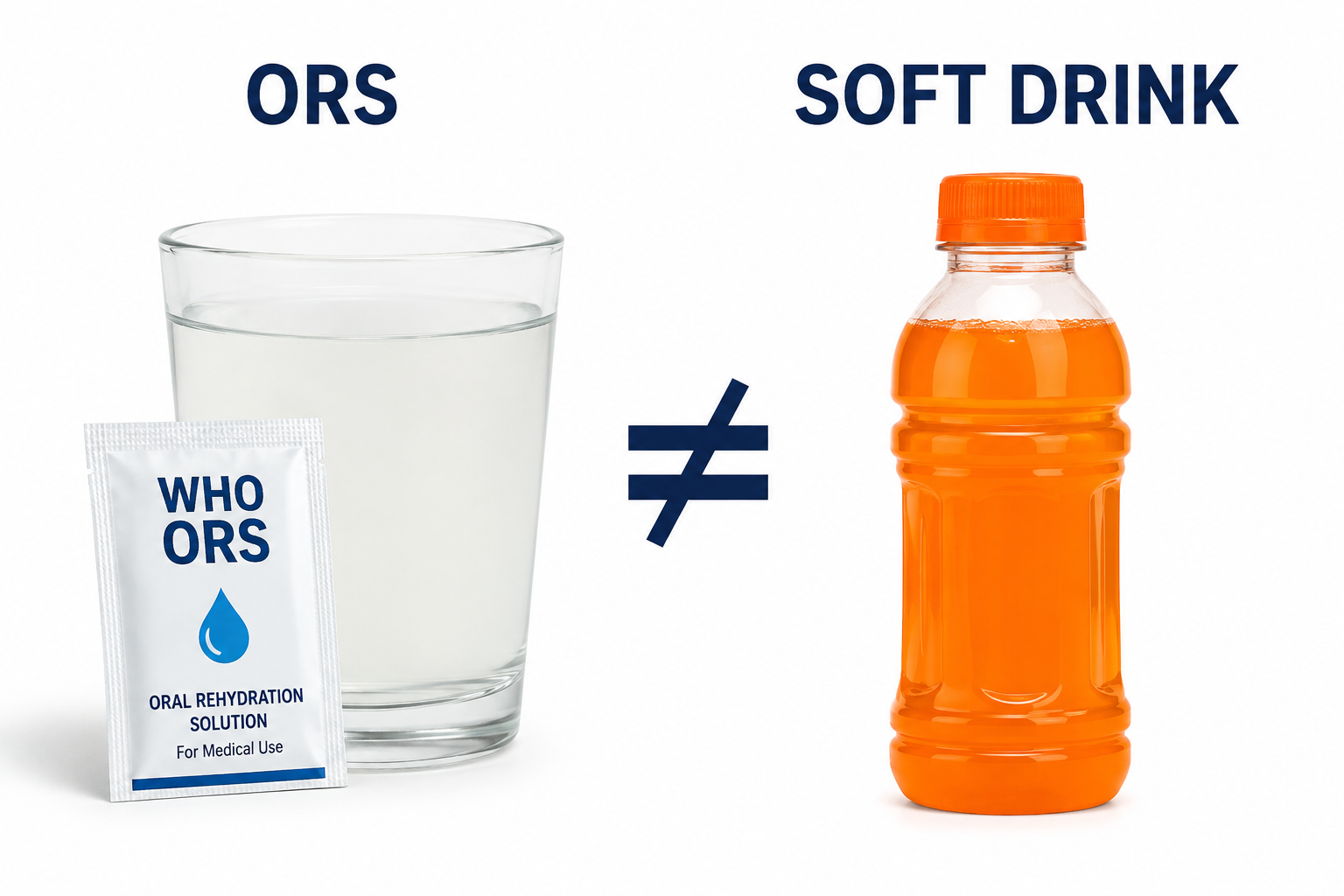
Recent discussions in the media and on social platforms have brought renewed focus to a critical public health issue: the widespread marketing of flavored beverages as “Oral Rehydration Solutions” (ORS). The core problem is not merely semantic. Consumers often assume that any product labelled as ORS has the same therapeutic efficacy as a WHO-approved medical formulation. This misunderstanding can be dangerous, particularly for children and other vulnerable patients relying on ORS to manage diarrhoeal illnesses. The controversy escalated when the Food Safety and Standards Authority of India (FSSAI) prohibited beverages that do not meet WHO standards from using the term “ORS”. That prohibition was initially stayed by the Delhi High Court through an unreasoned interim order. However, the legal position has since shifted. The Court has now clarified its stance, ultimately deferring to FSSAI’s regulatory expertise and allowing the prohibition on the use of “ORS” to stand. This piece traces how the dispute evolved both regulatorily and judicially and analyses its significance through the lens of trademark law.
HOW THE DISPUTE UNFOLDED
For over two decades, Indian markets have seen the sale of fruit-flavored electrolyte drinks branded in ways that closely associate them with medical ORS. One of the earliest examples was “ORS-L”, launched by Jagdale Industries in 2003. Johnson & Johnson later acquired the product in 2014 and rebranded it as “ORSL”, along with securing trademark registrations for the mark and related variants. Similar naming strategies were subsequently adopted by several other manufacturers. The difficulty was that many of these products bore little resemblance to WHO-approved ORS formulations. Instead, they contained substantially higher levels of sugar and functioned more like flavored beverages than therapeutic solutions. When administered to patients suffering from diarrhoeal or gastroenteritis particularly children such products risked worsening dehydration rather than alleviating it. India’s high childhood mortality linked to diarrhoeal diseases made this concern especially acute. Medical professionals had flagged this problem repeatedly over the years. Among the most prominent voices was pediatrician Dr. Sivaranjini Santosh, whose sustained advocacy over nearly a decade helped draw regulatory attention to the misleading use of ORS branding.
FSSAI STEPS IN
In April 2022, FSSAI issued its first formal directive addressing the issue. It observed that the use of “ORS” in product names such as “ORSL” or “ELECTROORS” could mislead consumers and potentially violate provisions of the Food Safety and Standards Act, 2006 (FSS Act). A few months later, in July 2022, FSSAI granted a temporary relaxation. Manufacturers were permitted to continue using ORS-based trademarks until the Controller General of Patents, Designs and Trade Marks (CGPDTM) provided further clarification. Although the CGPDTM’s decision was not made public, it was later referred to in an FSSAI order issued in February 2024. That order adopted a middle-path approach. It allowed limited use of “ORS” in trademarks, subject to two conditions: first, the term could only appear as part of a larger composite mark rather than standing alone; second, product labels had to clearly state that the beverage did not conform to WHO standards for medical ORS. Over time, FSSAI concluded that these safeguards were inadequate. Disclosure requirements, it reasoned, could not effectively counteract entrenched consumer perceptions. Consequently, in October 2025, FSSAI issued a final order imposing a complete ban on the use of “ORS” in relation to beverages.
THE COURTS ENTER THE PICTURE
Judicial scrutiny began when Johnson & Johnson challenged the October 2025 prohibition. On 17 October 2025, the Delhi High Court stayed FSSAI’s order. The stay was granted without reasons, which attracted criticism given the public health stakes involved. Media coverage suggested that the Court may have taken into account J&J’s claim of unsold inventory worth Rs. 155 crores, though this was never formally recorded. The Court later clarified that its intention was limited: the stay was meant to give FSSAI an opportunity to consider the company’s representations and issue a reasoned decision. FSSAI appears to have complied by issuing a detailed order on 30 October 2025, though this document is not publicly accessible. The legal position was clarified soon thereafter in Dr. Reddy’s Laboratories Ltd. v. Union of India (Delhi High Court, 31 October 2025). Dr. Reddy’s sought parity with J&J to continue marketing its product “Rebalanz VITORS”. The Court declined, stressing that judicial bodies should not substitute their views for the technical assessments of expert regulators, particularly where public health is involved. The prohibition on the use of “ORS” was upheld, with the Court leaving the handling of existing stock to FSSAI’s discretion.
TRADEMARK LAW MEETS PUBLIC HEALTH
The final outcome represents a reaffirmation of a long-standing principle: commercial and trademark interests must yield where public health is at risk. In endorsing FSSAI’s position, the Delhi High Court effectively corrected its earlier interim approach, which had momentarily privileged private economic concerns over regulatory judgment. FSSAI’s reasoning drew support from the Supreme Court’s decision in Ram Nath v. State of Uttar Pradesh (2024), which interpreted Section 89 of the FSS Act as granting it overriding effect over other laws. This means that statutory trademark rights cannot be relied upon to legitimize misleading food labelling. Given the binding nature of this precedent, the initial judicial hesitation appears to have introduced unnecessary complexity into what was otherwise a clear and settled legal framework. Importantly, the Trade Marks Act, 1999 itself incorporates consumer-centric safeguards. Section 9(2)(a) prohibits the registration of marks that are deceptive or likely to confuse the public. Courts have applied this provision rigorously with particular cases involving medicinal products, recognizing that even minimal consumer confusion can lead to serious public health consequences. The Bombay High Court’s decision in Macleods Pharmaceuticals v. Union of India (2023) is illustrative, as it lowered the evidentiary threshold for establishing deception in light of public health risks. FSSAI also emphasized that “ORS” is an International Non-Proprietary Name (INN) designated by the WHO. INNs are intended to remain freely available to ensure uniform identification of essential medicines. Reflecting this policy, Section 13(b) of the Trade Marks Act bars their registration, preventing any single entity from claiming exclusive rights over critical medical terminology.
CONCLUSION
The ORS controversy illustrates the limits of trademark protection in sectors where consumer safety and public health are paramount. By ultimately upholding FSSAI’s prohibition on the use of “ORS” for non-WHO-compliant beverages, the Delhi High Court reaffirmed the principle that regulatory expertise must prevail over private commercial interests, particularly where misleading representations can have life-threatening consequences. The episode also underscores the coherence of India’s statutory framework: the Food Safety and Standards Act, reinforced by the Trade Marks Act, does not permit proprietary claims over medical terminology that carries established therapeutic meaning. In recognizing “ORS” as a term that cannot be diluted by branding or disclaimers, the decision strengthens consumer protection and aligns trademark jurisprudence with public health imperatives. Ultimately, the case serves as a reminder that in matters affecting health, clarity is not merely desirable it is legally and ethically indispensable.

Leave a Reply